Skip to content

What’s going on with Billy Moore?
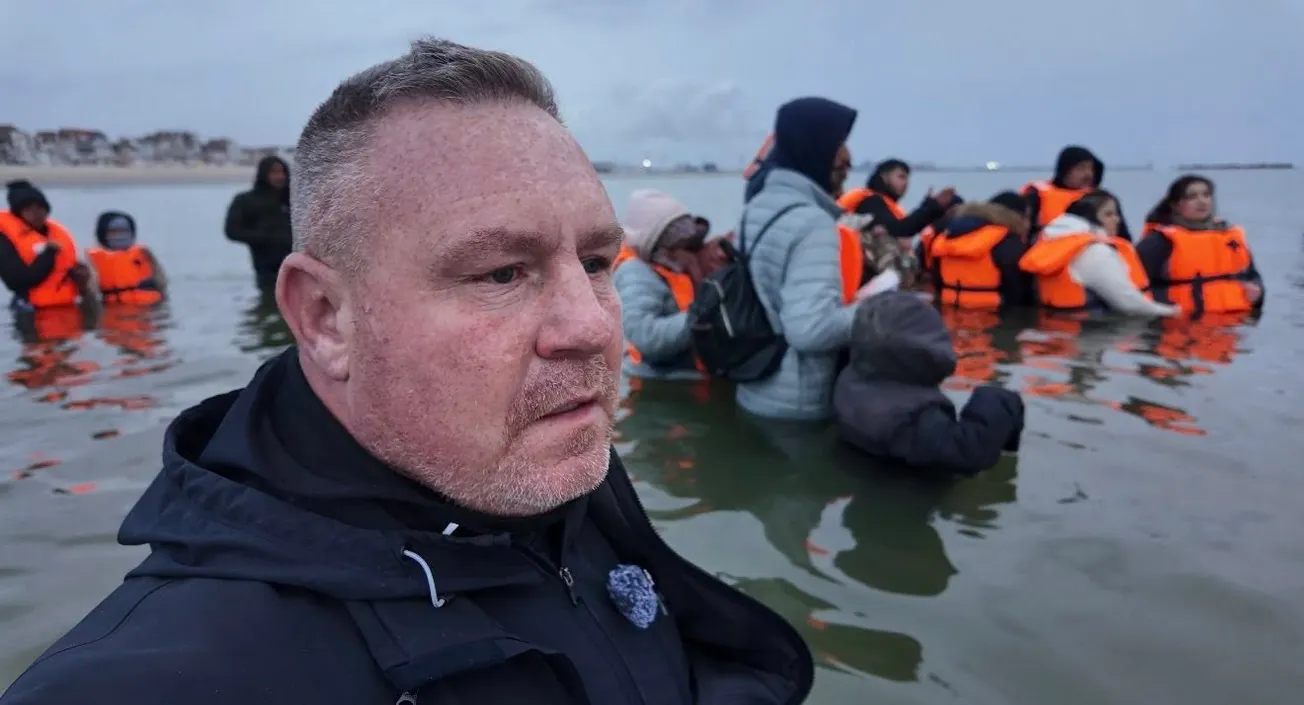
Billy Moore in the English Channel. Photo: Billy Moore

The Prayer Before Dawn star is going viral for all the wrong reasons. We ask him if he’s really turned to the “far-right.”

Billy Moore isn’t happy. He’s trying to get to the gym, but has a demanding toddler running around and a Shih Tzu with “a lump on its arse” that needs to be taken the vet. He’s also had to phone me, because I’ve been contacting figures associated with the far-right, conspiratorial or anti-immigrant wing of online content creation and asking them if they now consider Billy one of their own. 

“Charlie and Liam sent me your emails,” he says in a Scouse accent only sharpened during years living abroad. He means Charlie Veitch, the YouTube provocateur whose run-ins with drug addicts and the homeless have made him a controversial figure across the North West, and Liam Tuffs, the ex-offender whose The Dozen podcast Billy recently appeared on. “First off, I’m not an ‘auditor’...” 

He says the word like I’d accused him of being something filthy or perverted. Auditing, according to Hope Not Hate, is a growing trend on the far-right. They’re a kind of influencer, typically presenting themselves as citizen journalists exposing the asylum system.
Moore is like the Scarlet Pimpernel of Britain's social fractures. Just in the last few months, he’s popped up in Bradford, Rotherham, Blackburn and Rhyl, broadcasting to his 412,000 subscribers. This makes him, in all likelihood, Liverpool’s journalist with the best hustle and the biggest reach, “citizen” or otherwise. Often he’s at demonstrations, because “that’s where the action is.” 

Pushing the boat out, he has this week been to Calais and Dunkirk “to see what it’s all about.” While most Scouse influencers were seemingly at the opening of Crabbish on Duke Street, photos and videos of Moore half-submerged in the English Channel appeared. They feature wretched families in hoodies, parkas and life-jackets wading waist-deep through the water, presumably towards a dinghy that will ferry them across to Dover. His captions rage against “alpha males” abandoning their families right there on the Côte d’Opale. 
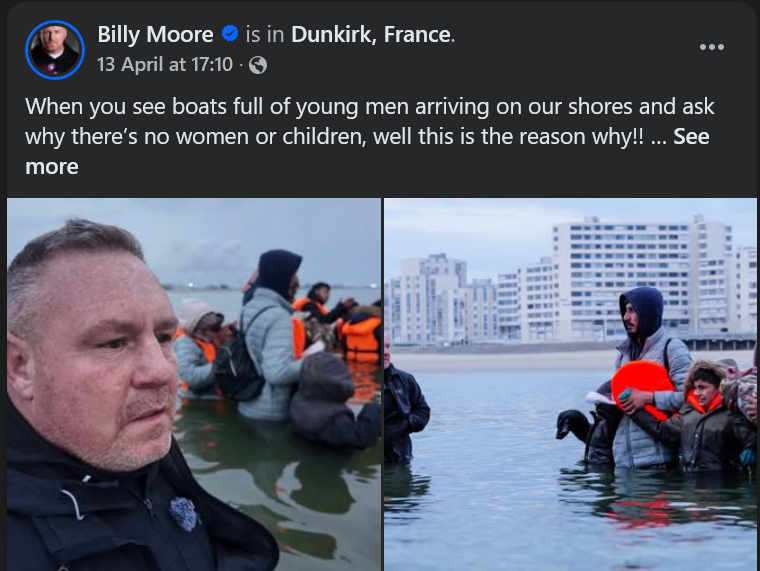
Screengrab from Facebook.

“What happened to women and children first?” he asks in a subsequent video, unknowingly echoing a man who lectured me on “the Birkenhead drill” outside a migrant hotel last year. And yet, Billy rejects the auditor label — or even a definite “right-wing” characterisation. 

“I never knew anything about ‘left-wing’ or ‘right-wing’,” he tells me on the phone. That all changed, he says, on 29 July 2024 — when Axel Rudakubana murdered three little girls in a frenzied stabbing in Southport.

“I started trying to speak to people on the left side,” he says. “And they were very abrasive and abusive and labelling me a Nazi. Like, oh my God, why am I getting called this? Why am I getting called a racist?” 

You may have seen some of these more recent abrasive conversations between Billy and presumably left-wing young Scouse men. The first, uploaded last week to social media by Moore himself, begins with a lad in a green beanie calling him a “little right-wing piece of filth” on Whitechapel and accusing him of exploiting the homeless for content. The second, also available via Moore’s “All or Nothing” channel, features a fella at Aintree, suited and booted for the Grand National, calling Moore “a horrible c***” and “a former smackhead.” (It should be noted that Moore’s interlocutor does not appear perfectly lucid himself.) 

Both videos currently have hundreds and thousands of likes and shares across social media. Almost entirely, these responses are split down partisan political lines. Left-wing accounts exult in yet more proof that Liverpool is the socialist exception to the stereotype of northern post-industrial working-class cities, ready to “bash the fash” anytime. By contrast, right-coded commenters are in awe of Billy’s restraint, managing not to respond physically when the man in the beanie calls him “a big fat flap-arse”. 

To call Moore a marmite figure at this point would be an understatement. Most people who approach him during filming seem to be genuinely made up to see him — at least, after he’s edited the videos. Those who comment beneath his YouTubes are generally appreciative. 

Elsewhere, it’s a different story. On other social media platforms, you won’t have to do much looking to find someone with a bad word to say about Billy Moore (a quick scan of X turns up “traitor”, “scumbag”, and “virus”, among others).

I first met Moore a few months ago on Church Street. Moderately face-blind, the first thing I noticed was his head: this impressive artefact, with its scar tissue of geological profundity and half an ear missing could, perhaps, only have been carved by decades of schoolboy boxing, house robbing, Thai fighting, a stay at Walton nick, and — in the case of the ear, a teenage scrap over Easter eggs. The head sits atop a short but stocky and powerfully built frame. There’s little doubt in my mind that he could, as he claims, “put you to bed” if he so wanted. 

Moore, you see, has been cursed by an interesting life. The ex-fighter grew up on a council estate, the eldest of six siblings and not just working-class but in outright poverty. Early on, he fell into a life of crime and heroin addiction. 

In 2005, Moore moved to Thailand to start afresh. He enjoyed some initial success, body-doubling for Sylvester Stallone in Rambo IV, and transitioning his boxing pedigree into competitive Muay Thai, the country’s particularly brutal national combat sport. But he soon fell into old habits. He became addicted to ya ba, a potent methamphetamine, and resorted to stealing and handling stolen goods. That’s how he found himself back in prison — this time, in the notorious “Bangkok Hilton.” He describes his internment in his memoir:

“We all then marched to the cell block and were shoved inside a cage. The room was big, but not big enough for the 70 Thai prisoners it was holding… The smell of human faeces was so strong I wanted to vomit… The cell resembled a mass grave with arms and legs all over each other. I saw a motionless body on the damp, stained mattress, insects hovering all over him…”

Moore later transmuted this hell into a new career: writing. His 2011 memoir, A Prayer Before Dawn, told of his experiences on the prison’s Muay Thai training team, which he joined to avoid gang violence. It was adapted into a 2017 movie starring Joe “Peaky Blinders” Cole, the moderate success of which was, at the time, lauded as a redemption arc for Moore — that is, until he missed the premiere after getting nicked for burgling a neighbour’s house.

Joe Cole stars as Billy Moore in A Prayer Before Dawn. Photo: Netflix

I speak with someone who worked on the Prayer Before Dawn film, who does not want to be named. They’re somewhat disparaging of Moore’s prose, which might be why the movie version has barely any English dialogue or subtitles for the first two thirds of the film. It’s an effective cinematic technique, highlighting the protagonist’s isolation and the claustrophobic environment. 

But I disagree that Moore isn’t a good writer. He’s occasionally tautological and repetitive, and some chapter beginnings read like they were imported from Wikipedia. But he’s remarkably sincere about his past, his self-destructive impulses and his capacity to use other people. Stories about his father punching him on his fifteenth birthday, or Billy recoiling from a hug from a rehab councillor because of how alien the concept of affection was to him, are genuinely moving. He extends his empathy – and sometimes even friendship – to addicts, criminals, “ladyboys” and derelicts. He’s also funny: read about his mounting panic when he is made to do squats by Thai screws after hiding illicit material up his arse. Moore’s experiences are so far from my own that understanding his perspective will take more than a half-hour phone call. 

In 2019, Moore started the All or Nothing podcast. Typical early content could be chats with his autistic younger brother Joe, whom Billy clearly loves to bits, or sit-down interviews with local figures like boxer Jazza Dickens, actor Margi Clarke and pre-fame MMA fighter Paddy “the Baddy” Pimblett. Subjects include his cancer diagnosis, gym tips, and guests opening up about their personal demons. Some videos are just Billy sitting in his car philosophising about his life. 

Some of Moore’s early YouTube content.

At some point, All or Nothing’s direction changed. In March 2024, several months before the Southport murders that he says altered his perspective, he posted a video entitled “Asylum seekers will be offered £3,000 by the government to voluntarily go to Rwanda.” In the video, he confesses that he doesn’t like talking about this divisive issue.

“I’m not against immigration,” he says, “it’s just the volume. It’s wave after wave after wave.” He says £3,000 should be given to the homeless, people in prison needing rehabilitation or those reliant on food banks. 

In the months leading up to July 2024, All or Nothing seems to be suffering an identity crisis. Moore still posts interviews, in-car monologues and conversations with family members. But videos about deprivation start to appear. Moore visits a “toxic slum” in Morecambe and a “hellish ghetto” on Barrow Island. “Do Albanian gangs run Liverpool?” asks one headline. 

After Southport, this tonal shift accelerates: caps-locks, exclamation marks and thumbnail images cleverly teasing conflict or even violence are more frequent. “OUTRAGE in Southport,” begins a headline posted by Moore on 31st July, “3 children tragically killed THE COMMUNITY TAKE ACTION.” In the video, Moore fights back tears as he sees residents holding a vigil and laying flowers for the murdered girls. The video ends with the riots beginning, Moore striding away from flames and black smoke rising into the evening sky. 

A month later Moore’s channel settles into its current format. The sit down interviews disappear. No more waiting for notoriety to come to him — Moore now seeks out controversy, filming with a professional consistency from “apocalyptic” estates, “chaotic” nights out and, of course, protests and counter-demos. Depending on the subject matter, it’s not unusual for him to receive 250,000 views, compared to the 10-50,000 he might have expected in the podcast’s early years.

Moore’s recent Youtube videos.

In October 2024, his first video featuring Veitch appears. The encounter seems unplanned, with both men just happening to be filming in Piccadilly Gardens in Manchester. Moore actually reprimands Veitch for mocking “crackheads” and other addicts in his YouTube output. But Veitch – who, if you’ve never seen him, looks a bit like a crazed llama with a GoPro and alopecia – is charming and complimentary throughout. If you didn’t know better, you’d say he was winning him round. 

Even if they're well-intentioned, the recent videos of Scousers standing up to Moore seem counterproductive, if not bourgeois contempt. Calling him out for exploiting the homeless for content might pass as fair comment depending on your point of view on filming vulnerable people, but not everyone sees it that way.

Anthony, AKA "Turbo", is a former addict and rough sleeper on the streets of Manchester, a regular fixture in Moore's social media content whom Moore is keen for me to speak to. Turbo couldn't be more equivocal about the difference between Veitch and Moore. He describes how the former would deliberately antagonise him off camera, and then switch it on when he was wound up enough. By contrast, Moore, whom Turbo met when he was at his lowest ebb, gave him his time and attention off camera, supporting him in any way he could.

"I'm out with my kids tomorrow, and I've just been in my mum's house for the first time in 10 years," Turbo says. Last week, he even competed in a boxing match, defeating his opponent in the second round. He attributes much of his recovery to Billy's belief in him. He's appeared several times in Moore's social media output, but says, "People don't see what he was saying to me off camera."

Furthermore, calling Billy a former smackhead is surely a compliment. In his memoirs, Moore is not exactly shy about his addictions. He describes himself in A Prayer Before Dawn as “a world-class card carrying pleasure seeker.” Despite this, he has been clean for eight years, and that 2018 conviction was his last. Those arguing Moore is a crypto-Nazi — or crypto-anything — have their work ahead of them.

“People call me Islamophobic,” he says, incredulity rising in his voice. “Mate, I was a fuckin’ Muslim for two years! I read the Qur’an and I changed my religion to Islam!” 

In recent years, there’s rightly been a recognition of the danger that social media platforms pose to consumers, especially young men enamoured of the likes of Andrew Tate (another Muslim convert, incidentally). Less attention, to my knowledge, has been paid to the psychological effects on content creators themselves. Louis Theroux’s recent documentary on “the Manosphere” left me sympathising with the influenced but also pitying the influencers, for all their wealth and prestige. The affirmation they receive from fellow creators, fans and sycophants is also a kind of inescapable addiction. I ask Moore whether there’s a risk of being suckered into a world where he does, indeed, become political.

“There’s no YouTubers on the left side documenting anything,” he says. The right-wing, by contrast, seemed to Billy more than happy to ask and answer the kinds of questions he was curious about. That said, he doesn’t agree with many of the people he’s being lumped in with.

“Ninety percent of the people I speak to on [the right] are just concerned parents,” he says. “Most are very nice people — although there are some horrible ones as well, and I just distance myself. Charlie Veitch, I don’t even know what he believes,” Billy says, and tells me Veitch is very different off camera to the instigator and professional irritant he plays on. “Liam [Tuffs], yeah, quite right-wing. Ryan Ferguson, I think he’s a pure racist.”

Moore (right) on Liam Tuffs’s podcast. Screengrab from YouTube

There’s a lot more I want to ask Billy. I really want to understand his story, and whether his own past might cause him to sympathise with refugees who make poor choices or even break the law. Does his commitment, stated in A Prayer Before Dawn, to always stick up for the underdog extend to those fleeing war and persecution? As a boxing fan, I’d like to talk more about his work promoting Weapons Down Gloves Up in Old Swan, an initiative trying to get kids out of gangs and into boxing rings. I am fascinated about his religious conversion story, and why he no longer prays five times a day. Since he hasn’t published anything since Fighting for My Life in 2020, I want to know whether he has now given up writing in favour of YouTube content — which, incidentally, I think would be a genuine shame. He agrees to meet me in person later that day. 

But in the afternoon, I receive a few cagey voice notes, one of which ends with, “I can’t stop you writing whatever you want to write.” I try to convince him, but it increasingly feels like I’ve lost his trust with some of my questions. 

Later that night, an update appears on Moore’s Facebook page:

I have no idea if that is about me. But it’s hard to escape the impression that Moore is becoming more guarded around people he considers his political opponents.

It's almost a cliché now that the right looks for converts while the left looks for traitors. And for all his life experience, Moore could be the perfect proving ground for this phenomenon. Often manifesting as sincere curiosity, Moore can seem naïve and easily led. But while he is, of course, responsible for his own actions, if it’s true that he's is on a journey closer to the likes of Veitch, Tuffs or even Ferguson, it feels like a collaborative project between both sides. His opponents could stop to consider what an asset he could have been to either.

If someone forwarded you this newsletter, click here to sign up to get quality local journalism in your inbox.


Comments

Latest