

The people's poet of Lark Lane
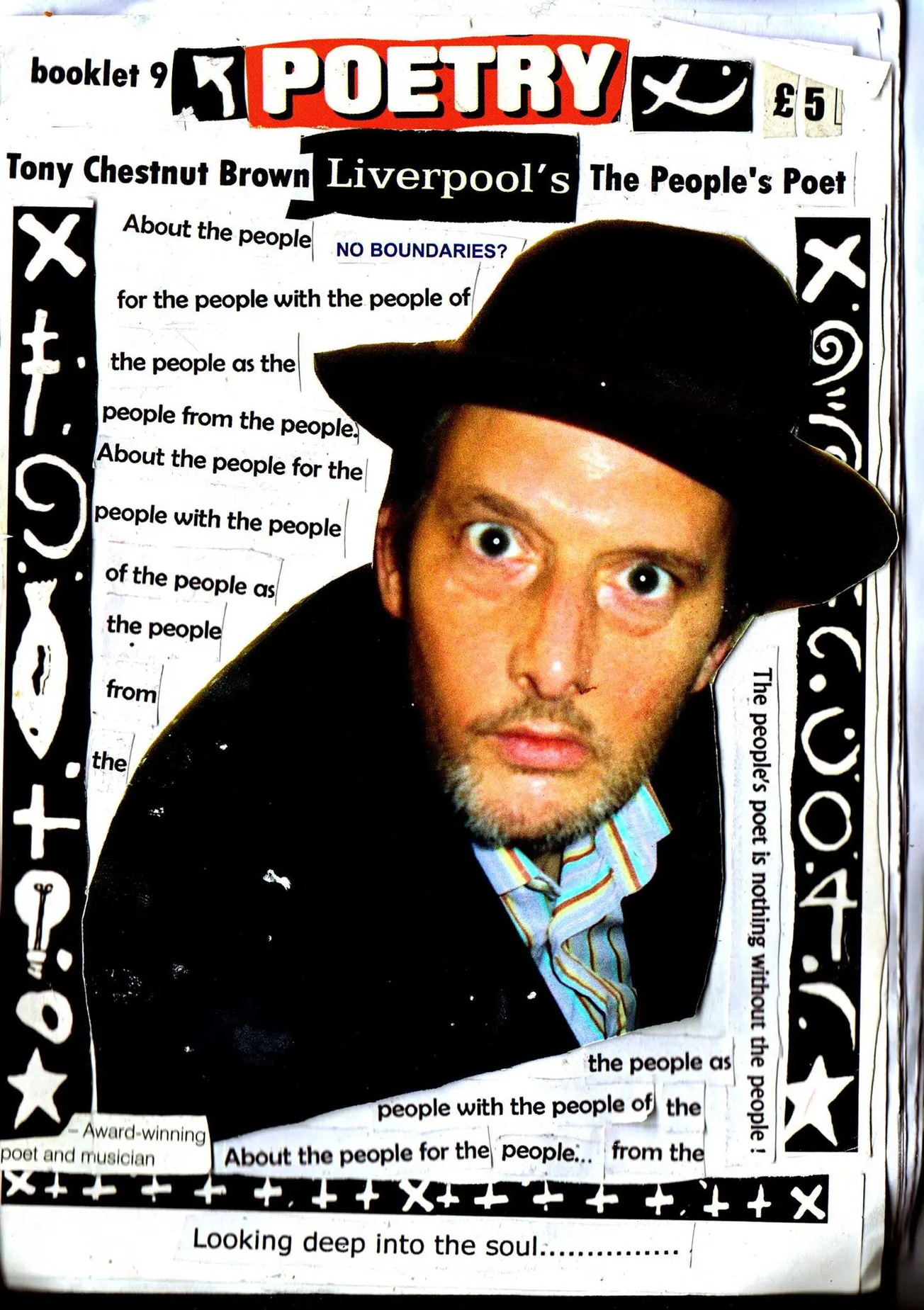
The life and times of Liverpool's beer garden bard
Dear members — today’s story is about Tony Chestnut Brown, a man best known for his poetry. His story offers an insight into what it’s like to live life on the fringes of society in Liverpool, amongst homeless people and drug dealers, and how childhood events can change our lives.
This edition of The Post is going out to 412 members. Thank you for your support, and if you’d like to share this story with a few friends, feel free to forward it on to spread the word.
Your Post news briefing
- Home Office figures show black people on Merseyside are disproportionately more likely to be arrested than white people. There were 539 arrests of black people on Merseyside in 2020-21: based on census figures, this works out at 37 arrests per 1,000 black residents in the area, compared to 11.5 arrests per 1,000 white residents. The justice and equality lobbying charity Liberty has called for police to not be given any further powers, but the Home Office says more work is being done to ensure everyone is policed without prejudice: “We now have the most diverse police force in history and have extensive safeguards in place to hold the police accountable.”
- The commissioner appointed to oversee Sefton council’s children’s services has been named as Paul Moffat, who will determine whether the most effective way of securing improvement is to remove the department from the authority’s control. Sefton’s children’s services received four damning reports in three years, citing an overreliance on private agency staff, low aspirations for care leavers, lack of suitable care placements and poor response to children at risk of exploitation. Go deeper with our analysis of why the council is in a precarious position and how standards dramatically dropped.
- The sudden appearance in these parts of a cluster of olive green subtropical songbirds, native to south east Asia, is causing concern about the effect of global warming on Britain’s climate. Interestingly, half the total biomass of England’s wild birds are already made up of non-native species: mandarin ducks, Canada geese, ring-necked parakeets, to name a few. One counter argument suggests that invasive non-native species can help build ecosystem resilience and encourage non-native species to be more adaptable, a useful trait in the era of climate change.
Post Picks
🎙 Professor Harold Hongju Koh, a professor of international law and currently Ukraine’s counsel against Russia at the International Court of Justice, is giving a talk at the University of Liverpool tomorrow afternoon. He will talk about how to restore the postwar liberal order and how well Joe Biden is doing in reversing the policies of Donald Trump. Book here.
🎨 Last chance to see Follow the River, Follow the Thread at Open Eye Gallery, a collection of three photography projects from the African continent, each exploring the human stories of climate breakdown. If you can’t make it in person, enter the exhibition online here.
📝 Local poet Iroro Azanuwha wrote a moving blog post about what inspired him to pursue creativity. Growing up in an alpha male environment, vulnerability was considered weakness and it was his sister who was a natural writer. But when she passed away after a long period of illness, he went to receive her Masters degree certificate on her behalf. “I decided I must write. I must pick up the torch and run with it and allow the fire from that torch to ignite something within me other than grief. Nearly two years on, I write because she wrote first.”
Tony Chestnut Brown was abandoned as a boy for a chain of chemist shops. So he says.
It went like this. Mother died young; father remarried; stepmother had “no soul or humour” and wore a Thatcherite hairdo and had a “suspicious” lack of interest in music. And she loved the royals. The only reason they married (after three months of knowing each other) — so he says — was because she wanted a daughter and he wanted her wealth. So it was a Faustian pact of sorts. He wanted that wealth for his chain of chemist shops. Once that was secured, “they tolerated each other”.
So he opened his chain of chemist shops and sent Tony and his older brother off to a Dickensian boarding school where canings were common and where his older brother developed a “sociopathic” coldness that he never shed. When their dad was dying, Tony still had time for him, but his brother didn’t. “He abandoned us,” he said. Tony couldn’t help but agree. “My spirit was denied as early as I can remember,” he tells me.
Tony’s face is a familiar one to a lot of people in Liverpool. Most know him from his homeless years spent bouncing from bar to bar, from the Albert Dock to Sefton Park and wherever else in between, selling scribbled poems that he would write on the spot, be it for the price of a pint, a meal or a fix. Many people have a Tony story, and most of these stories take place in smoking areas and at the back of dingy bars. I picture him as a kind of folk figure, wandering dusty roads and offering garbled snippets of wisdom to travellers who leave the encounter unsure whether they have hallucinated it.
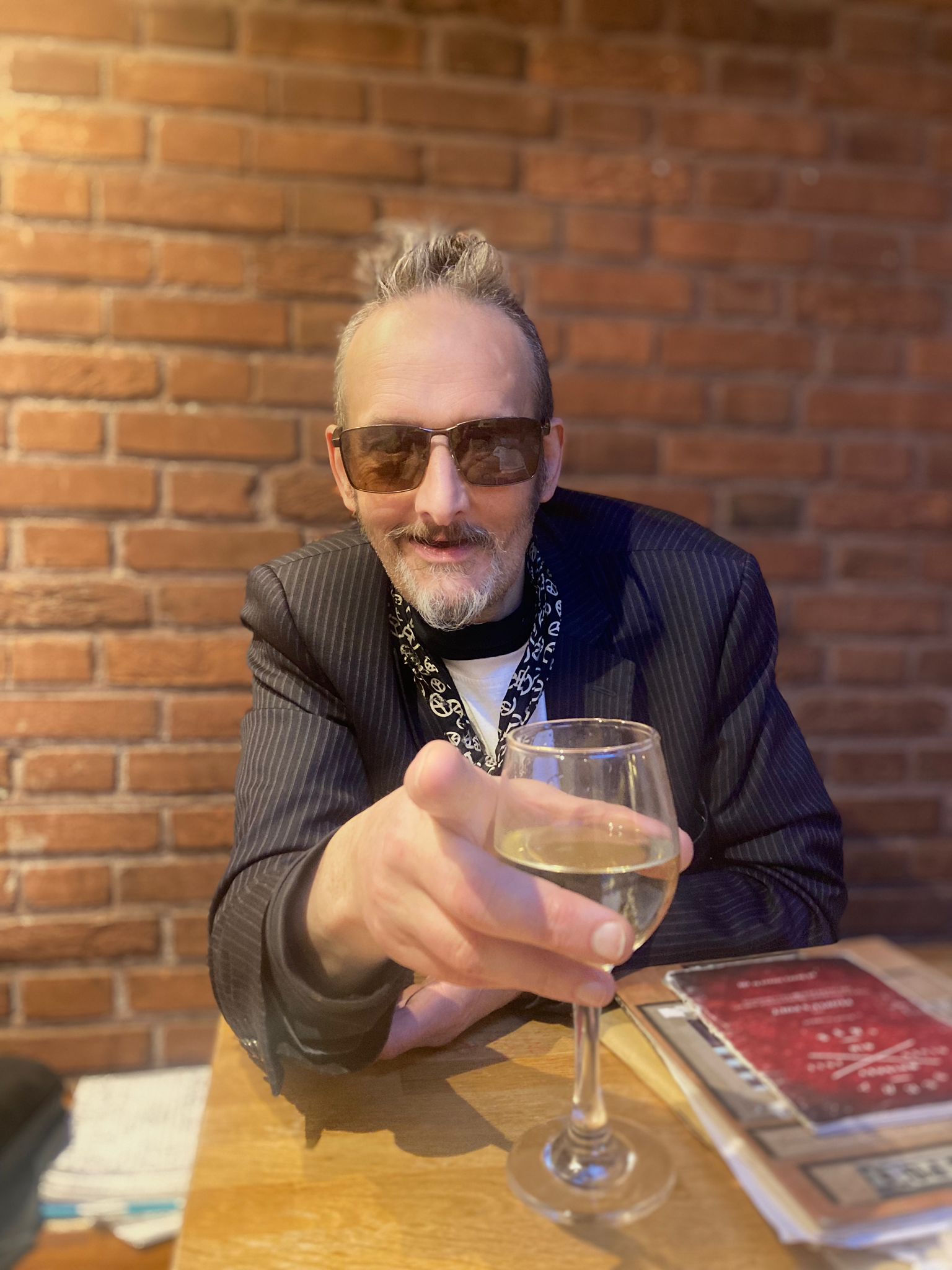
We meet at the back of Keith’s on Lark Lane and the staff know him at once. His words come out in bursts punctuated with abrupt pauses for thought, like someone might bang a sentence or two into a typewriter before stopping to chew on the next ones. He wears a fraying silk scarf strewn with peace symbols, a T-shirt with Boris Johnson’s face — eyes and mouth swiggled out in such a manner that makes it clear this garment is not meant as a compliment — a pinstripe blazer and his hair spiked into a kind of mohawk. It’s slightly dapper, slightly street.
Cheese and opiates
“Take me away to the lands of Wensleydale, Fresh not stale, Beyond the pale, Renate, Curd, Be deterred”
Prior to our meeting I can find little trace of Tony online. His own website hasn’t been updated in a decade and mentions of him elsewhere are limited to a brief chat on The Liverpool Way forum in 2009 where he is said to have concocted a poem on the theme of “cheese & opiates” in two minutes for the price of a pint at Heebie Jeebies (extract above) and a Reddit user bemoaning that the People’s Poet — as he would later become known — has yet to pay him back for a small amount of weed from 2002.
This amuses him. And to be fair, weed, opiates and poetry (perhaps not cheese) do all feature quite prominently in his tale. After he was expelled from boarding school — he and his best mate, the son of an international banker whose house had seven floors, were caught buying cider from an offy — Tony gravitated back towards music, his first love. The banker’s son was never expelled, which remains a bone of contention.
He worked in a furniture store and developed “a hatred for chipboard” as well as a sports shop, and then began playing in various bands in the late ‘80s. One of them — The Cromptons — went to meet with nationally renowned DJ John Peel to discuss a potential session, but Tony ran off to the toilets and blew it, torpedoing their best chance of mainstream success. Inexplicably, and despite making little ground in the UK, they became very popular in Germany before the fall of the Berlin Wall.
Details like that one — slightly random but often amusing and always dropped in casually — are a constant theme of Tony’s storytelling. After The Cromptons there was a stint as tour manager for the Boo Radleys in 1991, before he turned his hand to video jockeying, using his inheritance from his grandmother to set up a projections company. He started working for major techno artists such as Sven Väth, with whom he toured Europe for six years.
Life on the road was all “fast cars and that caper”. There were five star hotels in Frankfurt, shows where the noise and lights and lasers would pound for twelve hours until they penetrated the soul. There was even a performance on the jazz stage at Glastonbury. Most shows — themselves epics of endurance — were then followed by hours more of partying. Despite refusing the drugs that surrounded him initially, Tony eventually started having “a line or two” to keep him going. This was the start of a chain reaction of sorts.
His relationship with drugs had actually begun much earlier. Due to his father working as a chemist, and Tony occasionally doing shifts in the shop, he had access to various weird and wacky substances. Whilst his teenage mates were maybe experimenting with cheap booze and a spliff, Tony was like a 14-year-old mad scientist, mixing together things they’d never even heard of; Mogadon, Carbon Tetrachloride and the likes.
“By the end of 1999 I found myself living in the cellar of a man who didn’t know I was there,” he suddenly announces. Quite the statement, I ask for a little context. Having sacked a man who was working for him and replaced him — not deliberately — with a heroin addict earlier in the year, Tony soon found himself graduating to heroin use. It began an addiction that would last, despite regular attempts to get clean, for the next 21 years. Shortly after he began using the drug he found the pressure of his music work reaching breaking point and he had a mental breakdown, walking out of his house and leaving all of his possessions behind, save a big bag of videotapes.
“I walked into this complete other nexus of a world,” he tells me. He surfed couches for a while, then spent a while on the streets, before befriending a disabled man through the clubs where he spent much of his time. He crashed at the man’s house one night and ended up spending the next six months there, helping him to distribute “absolutely unbelievably vast” quantities of drugs to return the favour.
The man had lost feeling in the lower half of his body after contracting bird flu and was on sticks. Another man involved in the scheme then accused Tony of robbing the stash — something he vehemently still denies — and he was kicked out of the arrangement. With nowhere to go, he went back into the house when no one was in and settled in the gnarly, dank confines of the cellar, and spent a month sneaking in and out undetected and sleeping amidst the creepy crawlies.
‘Houshopping and other games’
“Down and down and down, deeper, darker, directly into the cruel embrace… payback is now due on the dalliances and debauchery that occurred when I danced with the devil”
From around the turn of 2000, Tony became fully homeless, spending the millennium celebrations wandering aimlessly “in an altered state,” with “an ulcer the size of a small crater” from a needle infection, to quote directly from his work. He spent a short while on the street before moving into a YMCA, or — as he terms it — “the why oh why oh why-MCA.”
Within the first few weeks he had his remaining possessions stolen — hair clippers and a pair of trainers — and saw another man get battered with the snapped off leg of a chair. He found himself in a tight spot. Not “the type” to go out mugging people for a fix, and with no possessions left to sell after the last of his record collection had gone, he instead went to the Big Issue office and became a magazine vendor.
James Street Station became his pitch. As Big Issue vendors have to buy their own stock, Tony developed a novel way of making his last. If anyone asked to buy a magazine, he’d offer them a poem — written on the spot — for the same price. It became his thing, the homeless guy at the station who can write a poem in a minute or two. He began building a reputation, getting requests for wives’ birthdays or upcoming weddings and was paid £500 for a graduation ball at Anfield, “tuxedos and all that caper.”
Most of his best poems were mini vignettes of incidents that occurred to him as he drifted through the nether-world of YMCAs, squat houses and doorways. In The kindness of strangers and other dangers he describes an incident where — whilst he was homeless — a man offered him £100 to break his jaw. Tony considered the offer, but the man was talked down by his friends and he left by shouting “fistful of fuck yous, as he threw, a handful of coins and crap at me with enough force to blind or break a jaw”. His poems are very much written to be performed, the intricate construction of wordplay and colloquial vernacular working best in the tempo of his own voice. A natural comparison might be Salfordian punk poet John Cooper Clarke. I say this. “He’s fucking crap,” Tony replies.
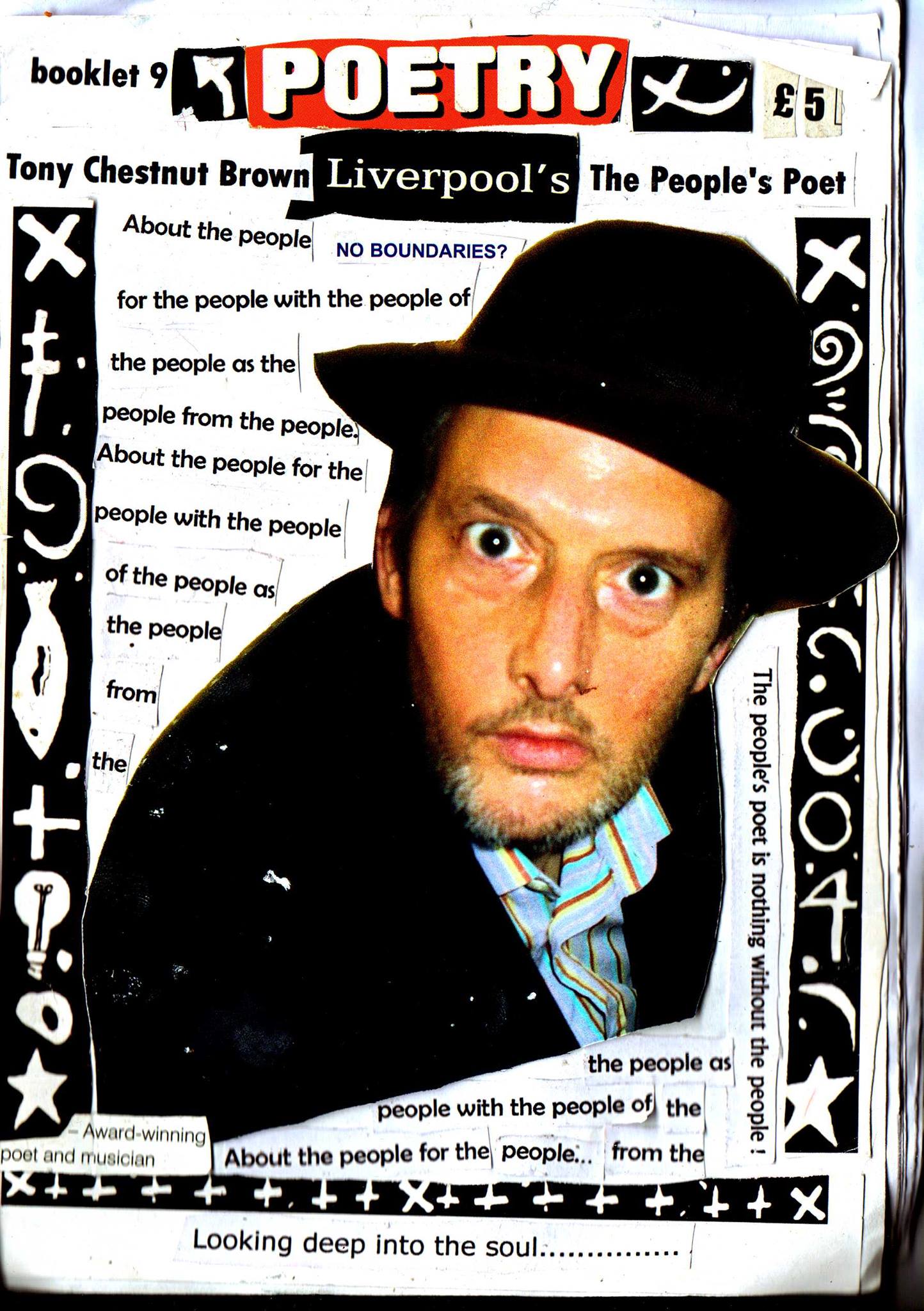
He became so widely known that in 2008 he was recognised by the council as “The People’s Poet of Liverpool” as part of the city’s push to become the European Capital of Culture. A brochure that was produced at the time has his moniker across the top and a collage of famous Liverpudlians; Wayne Rooney, The Beatles etc. He credits writing poetry with helping to refocus his life after feeling lost for several years. “There’s a fluidity when you put pen to paper that can’t be replicated,” he says.
Indeed, Tony without his pen in hand is like an amputee suffering from phantom limb syndrome. His fingers twitch as though searching for their missing component and his eyes dart around continuously like little balls trapped within the mechanism of a pinball machine. Occasionally I’ll ask a question and rather than reply he’ll lean into my voice recorder and shout some lines of poetry.
Looking back now, he sees the incident with his dad, and his stepmother, as the turning point in his life. “I was so happy back at junior school,” he tells me. He had mates, “loads of girlfriends”, blue stacked shoes and weird, long hair. He flunked the 11+ because he didn’t realise he was sitting the actual exam and off he went to boarding school. “As far as the authorities were concerned I was a fucking dimbo,” he says.
It probably didn’t make much difference which school he went to anyway. It’s hard to imagine Tony in any circumstance fastening his tie and falling into line. The expulsion, he assumes, was just an excuse on the part of the school who probably wanted him out by any means possible. “I didn’t fit in there at all,” he says. “I was into graffiti, they were into bullying.”
There’s no place like (no) home
“Have you ever stopped to wonder, About mice and men, In between living now and then, Yes, I tried the needle, So much evil, Avoid those bringing the bible, Anything for survival, Realise there’s no place like no home when you’re strung out caught in the wind and the rain and all alone”
By 2006, Tony had been kicked out of the YMCA after admitting to his drug use and moved into a squat with a group of dealers. Having only been there a short time — cue another baffling story told as though it were an afterthought — it was held to siege by yardies and he had to flee out the front window and across the roofs of several cars. His trouser leg was ripped by a pitbull mid-escape, so he says.
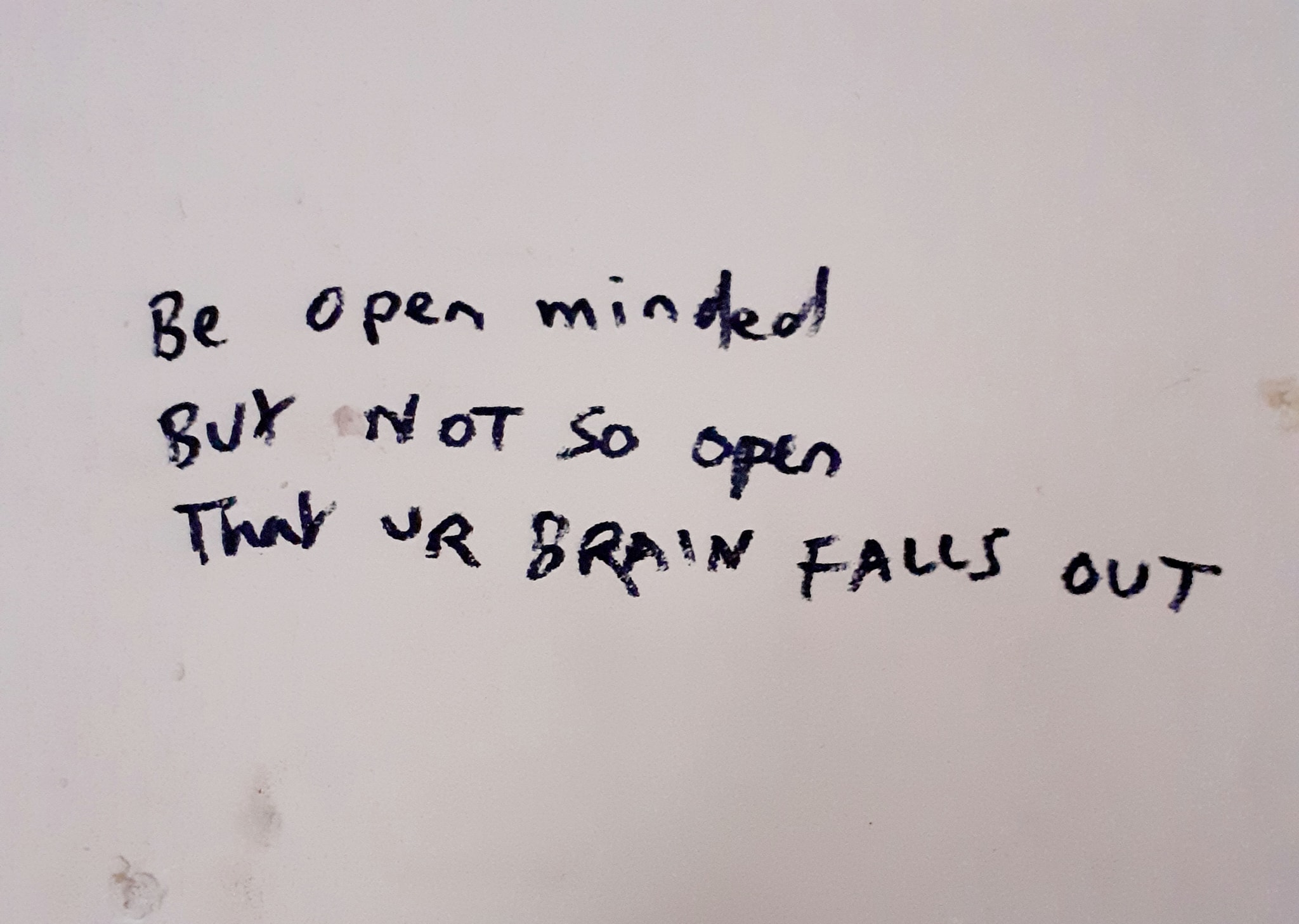
Finally, after one last halfway house, homelessness charity The Whitechapel Centre got him out and into a supported bedsit in 2007. It was his first step back towards normality, or as close to normality as a man like Tony would ever desire. From there he moved to his current place at Sefton Park where poetry is written up the walls in black pen.
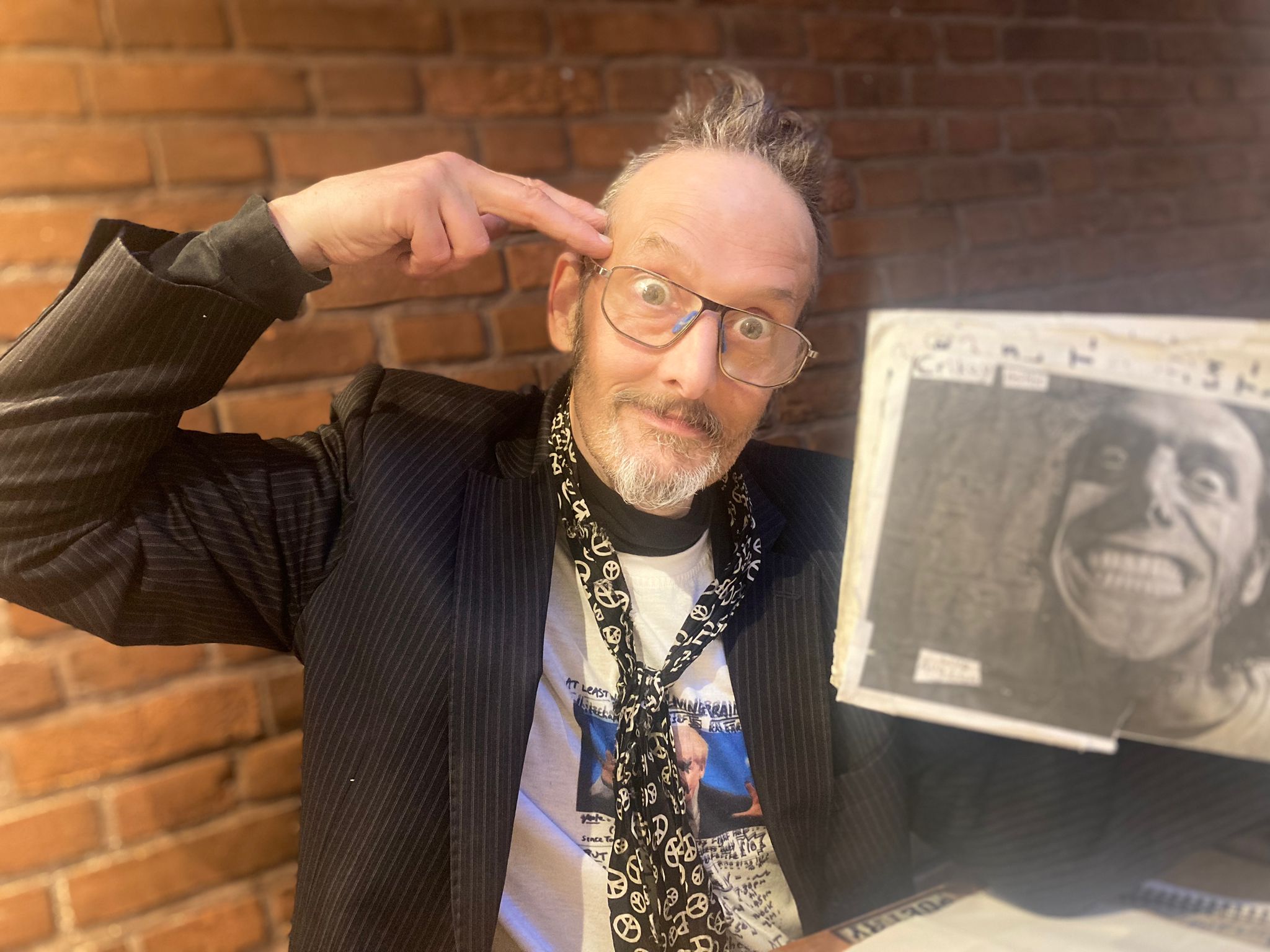
He’s now in recovery having stopped using heroin. “I give thanks I’ve still got my limbs,” he tells me as our conversation draws to a close. He raises money for The Whitechapel Centre as thank you for lifting him out of homelessness. The t-shirt he’s wearing — the Boris Johnson one — is merchandise from a recent event where they collected £650.
He still goes out amongst the homeless community in Liverpool too, and sees that the levels of suffering are worsening. And generosity so often comes with a clause: “I’ll give you this £10 note but can I see your arms first,” or “I’ll get you a Maccies but I can’t give cash”. The move to a cashless society has made things even more difficult, when he goes out busking as the People’s Poet he’s started taking a card reader.
And he’s performing as well, having been barred from three recent gigs with his group Obfusk8 for smashing a pint glass over his own head mid-performance and creating a large pool of blood. This fact causes him to roar with laughter. Obfusk8 are currently building themselves a studio, and Tony also performs solo under the name Tony Chestnut Sonic Artist.
It’s hard to establish a perfectly linear picture of the events of his life. His storytelling can muddle time zones and piece them back together haphazardly, a bit like poetry. Details of minor events exist in abundance whilst major sections of the story are blank. “ANYWHO,” he booms at regular intervals before completely changing pace and direction. When I ask where in Liverpool he was born he looks at me like as though I’ve said something grossly impertinent or weird, like I’ve asked about his grandmother’s weight. “Wirral, I think,” he finally says with a Gallic shrug. “I’m not of this planet anyway.”
Comments
Latest
Southport traded an Art Deco treasure for a glittering new events venue. Do the sums add up?
Can Formby’s red squirrels be saved?
Luxury student housing’s well and good — but I miss when Liverpool was bedsit land
Sefton aviary dispute continues to ruffle feathers
The people's poet of Lark Lane
The life and times of Liverpool's beer garden bard