

A chaotic afternoon with Reform’s newest Wirral recruits
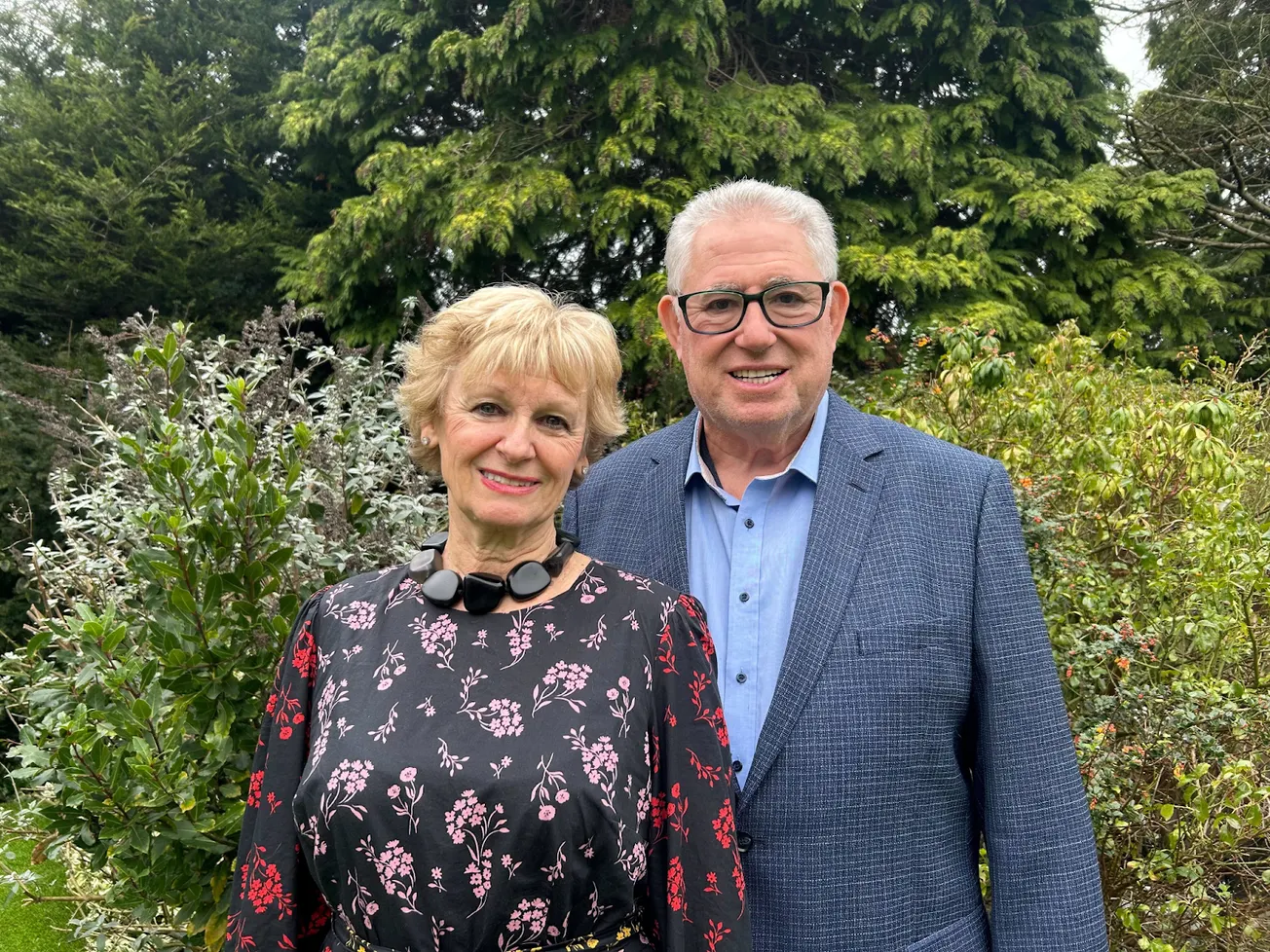
The Hodsons are ‘not political’, support utilities nationalisation and keep a few shotguns. What does their defection signal?
Dear readers — Last year, three councillors for the Heswall, Gayton and Barnston wards broke away from the Tory party, declaring themselves as “independent Conservatives.” Considering recent high profile defections to Reform UK, perhaps less shocking was the announcement last month that the trio of husband and wife Andrew and Kathryn Hodson and colleague Graham Davies had joined the Nigel Farage-led party.
Just over a year since Victor Floyd became Reform’s first Merseyside councillor, the party already has seven across the region. Farage has set 7 May as the deadline for further defections: will there be more across Merseyside before then? Is this just the start of a populist-right surge? And just how is Reform planning to simultaneously appeal to voters in working-class and well-to-do areas?
To find out, Laurence and Abi travelled to meet the Hodsons in their Gayton home. What began as a cordial morning became a somewhat chaotic afternoon. Read on to find out more.
But first, your Post briefing.
Welcome to The Post. We’re Liverpool's quality newspaper, delivered entirely by email. Sign up to our mailing list and get two totally free editions of The Post every week: a Monday briefing, full of everything you need to know about that’s going on in the city; and an in-depth weekend piece.
No ads, no gimmicks: just click the button below and get our unique brand of local journalism straight to your inbox.
Your Post briefing
“Persistent, wicked and abusive”: Merseyside Police have launched a new investigation into ex-Liverpool Labour councillor Gerard Woodhouse after his conviction in December for sending “persistent, wicked and abusive” cards to a fellow councillor Christine Banks. A BBC investigation found that police first received complaints about a series of poison pen letters sent to a member of the public over a decade ago — years before cards were sent to Banks. At the time, Woodhouse was not linked to these letters, however after samples of his handwriting were published by the BBC the victim has renewed their complaint to the police. Merseyside Police confirmed an inquiry has been relaunched due to “a victim coming forward". Read the full investigation by the BBC here.
Two New Brighton councillors have come under fire after “award[ing]” cash to two projects that were supposedly already earmarked for funding. In a statement posted by Labour councillors Sue Powell-Wilde and Tony Jones on Facebook this week, the pair wrote: “We received several very worthy project ideas from community leaders and businesses across New Brighton, and we are delighted to be able to award [funding to]... a series of street art celebrating local heroes and…the launch of a Creative Technology Hub”. In response, the New Brighton Coastal Community Team described the announcement as “sheer nerve” — adding: “These projects were earmarked for this funding before they tried to hijack it. Are they both going to support the local economy by calling for the parking charges to be reversed?” Things are certainly feeling tense over the water…
And some sad news for Walton’s Rice Lane City Farm, which is now facing permanent closure. The farm, which opened nearly 40 years ago, hit financial trouble last year and now needs to raise around £30,000 to stay open. Jamie Dowling, the farm's chair of trustees, said he would be “heartbroken” if it was forced to shut, adding: “I really want to keep it going but I'm not confident we can do it.” The farm needs cash for repair works to its barns and shelters, as well as food for the animals. A GoFundMe campaign has raised over £7,000 so far.
A chaotic afternoon with Reform’s newest Wirral recruits
“That’s the old windmill there,” Andrew Hodson says, pointing to a red sandstone tower a plot away. It’s old, grand, and redundant, its sails having fallen off sometime in the 1900s, but remains a landmark of no small local pride.
We’re standing in a beautifully maintained back garden in Gayton. It belongs to Andrew and his wife Kathryn. The former is keen to show me around but I’ve come to talk politics — the Hodsons are two of three local Wirral councillors who last month caused a stir by defecting to Reform UK after 32 and 14 years as Conservatives respectively. While Andrew shows me the sights, including a well-stocked country pub-like bar in the summerhouse, a brief scatter of wet snow barely dampens the lawn.
I want to know why this retirement-age, upper-middle-class couple decided to jump ship to a populist right-wing party after a long and mostly happy stint as Tories. But despite having served as a councillor since 1994, the houseproud Andrew describes himself as “not really political”, and is much happier showing off his possessions.
When I first arrived two hours previously, I was struck by the georgic pomp of Barnston and Gayton — with Heswall, two of the three wards now represented by Reform. (The Hodsons’ colleague, Graham Davies, another ex-Tory defector, is not able to join us.) Alongside the two country pubs nearby, the Glegg Arms and Devon Doorway, Gayton’s windmill marks one’s entrance into Merseyside from the Cheshire half of the Wirral peninsula.
The houses are old, large and well-to-do, but none more so than the Hodsons’, with its Range Rover and classic Bentley in the drive. “My pride and joy,” Andrew tells me, although I come to learn he has a lot of prides and joys.
After Andrew proudly shows me framed photos of the couple meeting Tory luminaries like Boris Johnson, Theresa May and Jacob Rees-Mogg, I sit in a pristine living room, creepingly self conscious of my own shabby appearance. In the front garden, a Union Jack flaps in the February breeze.
For the first half hour of my visit, I mostly chat to Kathy, who graciously plies me with cream coffee and delicious mint chocolate biscuits. Friendly, intelligent and unguarded, Kathy’s background was in finance as a manager of an Abbey National branch. Before that, she was brought up in a council house, and owes her conservatism to her parents’ gratitude to Margaret Thatcher for being able to afford to buy their home. Despite this, she says she wasn’t really political until she met Andrew in 1997, their courtship constantly interrupted by his dedication to canvassing and leafleting. They married a year later.
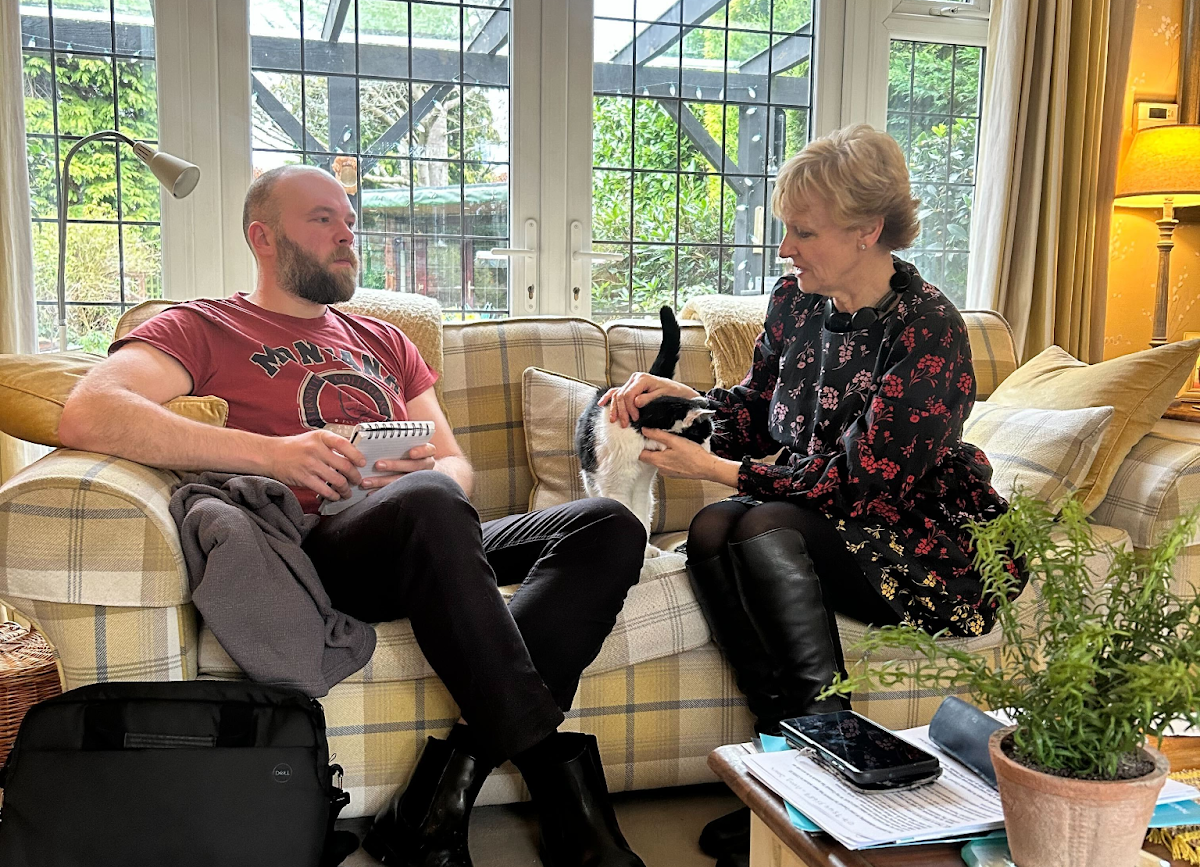
Andrew comes in and out, occasionally making quips — “You’ve not made us out to be the Ku Klux Klan yet, have you, Kath?”, sometimes accompanied by his friend Mark, a tall, grey-haired gentleman who’s come round to help Andrew with something, although I never discover what. Mark, I’m told, did four tours in Afghanistan and Iraq, fixing tanks and other ordnance under gunfire. He says he used to vote Labour, but is now intending to vote Reform.
Andrew built his own facility management and industrial cleaning firm, and freely admits he was drawn to the Conservatives because they “take care of you” if you’re in business. “Well, not ‘take care of you’,” he corrects himself, “but they do make things easier.”
Kathy has a keen interest in history. We talk about the lamentable decline of school Latin, the legacy of the British Empire going back to its Elizabethan founding, and her belief in the importance of patriotism regardless of a country’s past wrongs. As she’s now the leader of the Reform councillors group, I’m interested to know whether her views have evolved, or whether the modern Conservatives left her behind. Before the Hodsons defected to Reform, they briefly sat as independents in 2025.
“We feel we’ve stayed in the same place,” Andrew calls from over by the Aga, but that the Conservatives were no longer fit for purpose. Before he can expand on this, a knock at the cottage door draws him away.
“I began to think that the Conservatives had lost their way,” Kathy says, picking up the thread. “They weren’t the fiscally responsible party I thought they always would be.”
Was this during the Liz Truss, Kwasi Kwarteng era?
“Under David Cameron,” she says, surprising me. “That’s when they became more liberal. I thought then, these politicians who are coming in now, they’re not conviction politicians. They haven’t had a job, they haven’t been the director of a company, to be able to take those skills and see this is how you should manage a country. I voted for David Davis,” she says of the former Tate & Lyle senior executive and author of How to Turn Round a Company, who lost the 2005 party leadership race to Cameron.
I ask whether the liberal Cameron/Osborne era wasn’t just a continuation of the neoliberal economics the party embraced under Thatcher — after all, a radical departure from the Conservatives' more traditionalist past — and suggest that that might be what got the country into the mess it’s currently in. Kathy doesn’t disagree, and even says she is for the renationalisation of essential services like water and other utilities — “So long as it’s done correctly: we all remember how bad British Rail was!”
Before I can probe further, Andrew returns with my colleague Abi. When he finds out we’ve been discussing renationalisation, he rolls his eyes indulgently, as though he knew what he was getting into when he married a communist.
My more genial line of questioning gives way to Abi’s spikier style, until a kind of good cop, bad cop routine emerges, further confused by five people sometimes speaking over each other. Trying to keep things local, I infer from asides that the decision to break away from the local Conservative group was not wholly ideological: both Hodsons feel Kathy was unjustly passed over for the kind of leadership position she now holds. Meanwhile, Abi asks about the scandal over Reform leader Nigel Farage’s alleged tax avoidance.
“You’re advised to do it!” Andrew says.
“Everyone who puts money into an ISA is avoiding tax,” Kathy concurs.
What about the racist comments Farage allegedly made at school?
People of all ethnicities were created equal, says Kathy. “But we’ve probably all said things we’re not proud of as kids”.
About gassing Jews? Abi asks, referencing one of the songs a young Farage isaccused of singing.
“No, probably not,” Kathy says, before endeavouring to make a general point about how what's acceptable evolves over time. “When I was a little girl, if you went to buy cotton in a shop, and you went to the brown section, there would be ‘fawn brown’, and then there would be ‘n***er brown’." (She does not censor the word.)
This story is free to read - you just need to join our mailing list. And why wouldn't you? By becoming a Post subscriber, you'll get our scoops, features, and insights, in your inbox, the second we hit publish. No card details required.
Already have an account? Sign In
Latest
A dish best served cold: Laurence Westgaph sued us to reveal our sources - and lost
Steve Rotheram’s friends in high places
The children in the Travelodge
A slippery slope
A chaotic afternoon with Reform’s newest Wirral recruits
The Hodsons are ‘not political’, support utilities nationalisation and keep a few shotguns. What does their defection signal?