

Less than half of Liverpool has good access to green space. How can we fix it?
The Post looks to neighbouring cities to find out how we can benefit from better access to nature
Dear readers — over the summer, parks across the city have been full of folk wanting to kick back and unwind, play a game of football or catch some unpredictable sunshine. Yet for some of us, enjoying green spaces is easier than for others. The Post’s data reporter Daniel Timms has been looking into the dispersal of green spaces in Liverpool, and has discovered that less than half of all residents here have what is described as “good access” to parks and nature.
This is especially prominent in more economically deprived areas of the city, where residents often have to travel outside of their local area to reach an adequate green space to rest, exercise or play in. As one local councillor stressed to us: “It’s working class people that are affected most by our lack of green space”.
In today’s piece Daniel and Abi dig into the data and look to other cities across the UK — and the world — for solutions.
But first, your regularly scheduled Post briefing.
Welcome to The Post. We’re Liverpool's quality newspaper, delivered entirely by email. Sign up to our mailing list and get two totally free editions of The Post every week: a Monday briefing, full of everything you need to know about that’s going on in the city; and an in-depth weekend piece.
No ads, no gimmicks: just click the button below and get our unique brand of local journalism straight to your inbox.
Your Post briefing
An update for those of you following our Big Help investigation: Knowsley Foodbank, one of the charities previously central to the Big Help empire, is now also being investigated by The Charity Commission over concerns about the use of funds. The organisation was established to relieve poverty in the borough through a foodbank service and community store, but contacted the Charity Commission in June 2025 after allegations made by one of its grant providers. The commission will now investigate the charity’s management and administration. These matters will include potential conflicts of interest, whether funds have been properly expended, and whether the charity has sufficient trustees willing and capable of managing it in accordance with its governing document. Know any more about this story? As always, email abi@livpost.co.uk.
Liverpool has once again stood in for Gotham City. Streets around the Pier Head and Derby Square have been made over for DC Studios’ latest project, Clayface. Previously, The Batman (2022) also made use of Liverpool (and Glasgow) as the setting for Gotham, the notoriously corrupt and crime-ridden home of the Dark Knight, described by one Batman writer as resembling "Manhattan below Fourteenth Street at eleven minutes past midnight on the coldest night in November." The mayor’s office were quick to tout the honour, posting on social media that the spotlight had once again fallen on the city region as “the Hollywood of the North.”
And from one superhero to another: actor Philip Oliver is “surprised and delighted” to learn he will reprise his role as Brookside’s character Tinhead when the soap returns for a one-off Hollyoaks crossover episode later this year. Saying he remembered his time on Brookside “with great affection”, the Liverpool-born Oliver admitted he never thought people “would still be calling me Tinhead" 30 years after accepting the role aged 15. As Tinhead — the nickname of the character Timothy O’Leary — Oliver will join other returning cast members Suzanne Collins (Nikki Shadwick), Sue Johnston (Sheila Grant, later Corkhill), John McArdle (Billy Corkhill) and Paul Usher (Barry Grant). Filming is due to begin this month for a November release.
In today’s edition of Answers in The Post, we dig into the city’s green spaces, and how we could improve our access to them.
Why does green space matter?
According to a 2023 study by environmental academics Rebecca Geary and Daniel Thompson, living in greener areas — or close to “green” and “blue” spaces (like parks, lakes and beaches) — has close ties to better mental health and life satisfaction.
In their research, they studied communities in Wales over a ten-year period, and found that exposure to more greenness over time was linked to a reduced risk of common mental health disorders like anxiety and depression, especially in more economically deprived areas where residents are less likely to have their own outdoor spaces, like gardens and patios, to enjoy. In part, the mental health benefits were due to the increased social contact offered in community spaces like parks, and the stress-calming effects of nature.
But green spaces aren’t only good for our mental wellbeing. They also offer more direct physical health benefits, such as an opportunity to exercise and breathe in clean air. In Spain, a 2014 study found that living in “greener” neighbourhoods resulted in lower BMI and obesity rates among children, and in 2018 a study found those living near parks in England take part in up to 50% more physical activity.
So how much green space is there in Liverpool?
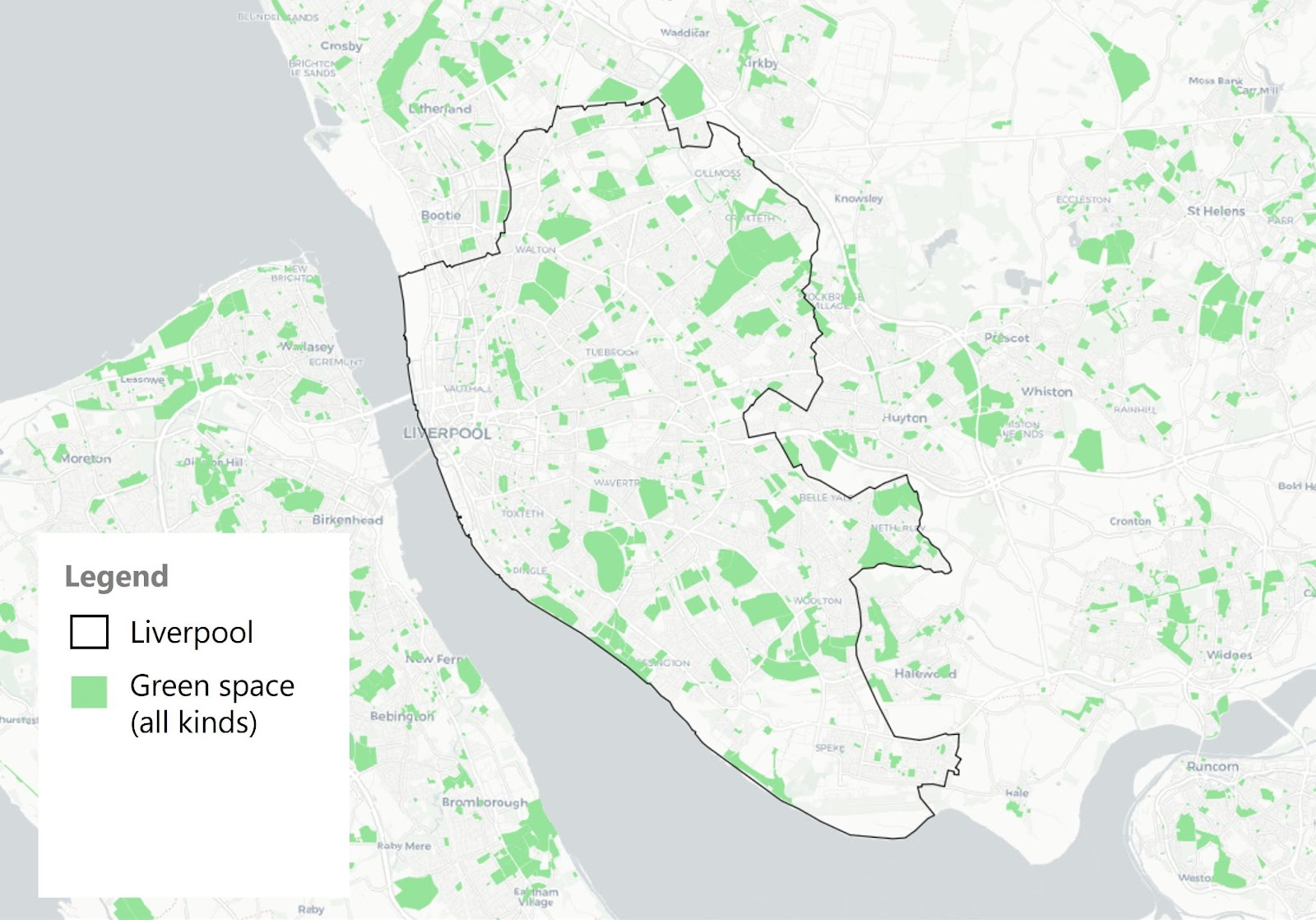
1,882 hectares, according to the Ordnance Survey. That figure is slightly meaningless on its own, but it’s the equivalent of almost exactly a sixth of the city’s area. You can see from the map below that there’s quite extensive coverage across the city.
How accessible are they?
A sixth of all land sounds good, but this is where it gets a bit more complicated. While those green spaces don’t include private gardens, they do include golf courses (like Allerton Park and West Derby golf courses), cemeteries, allotments and sports facilities. These spaces still provide some of the benefits of green space to people and the environment but not all the time. For example, you have to be an allotment holder to use that space, golf courses are exclusive, and cemeteries, while public, are often not suitable for leisure or recreation.
When we strip out everything that’s not a park, playing field or “play space”, the amount of green space that’s there for everyday use shrinks by over a third, as the map below shows.
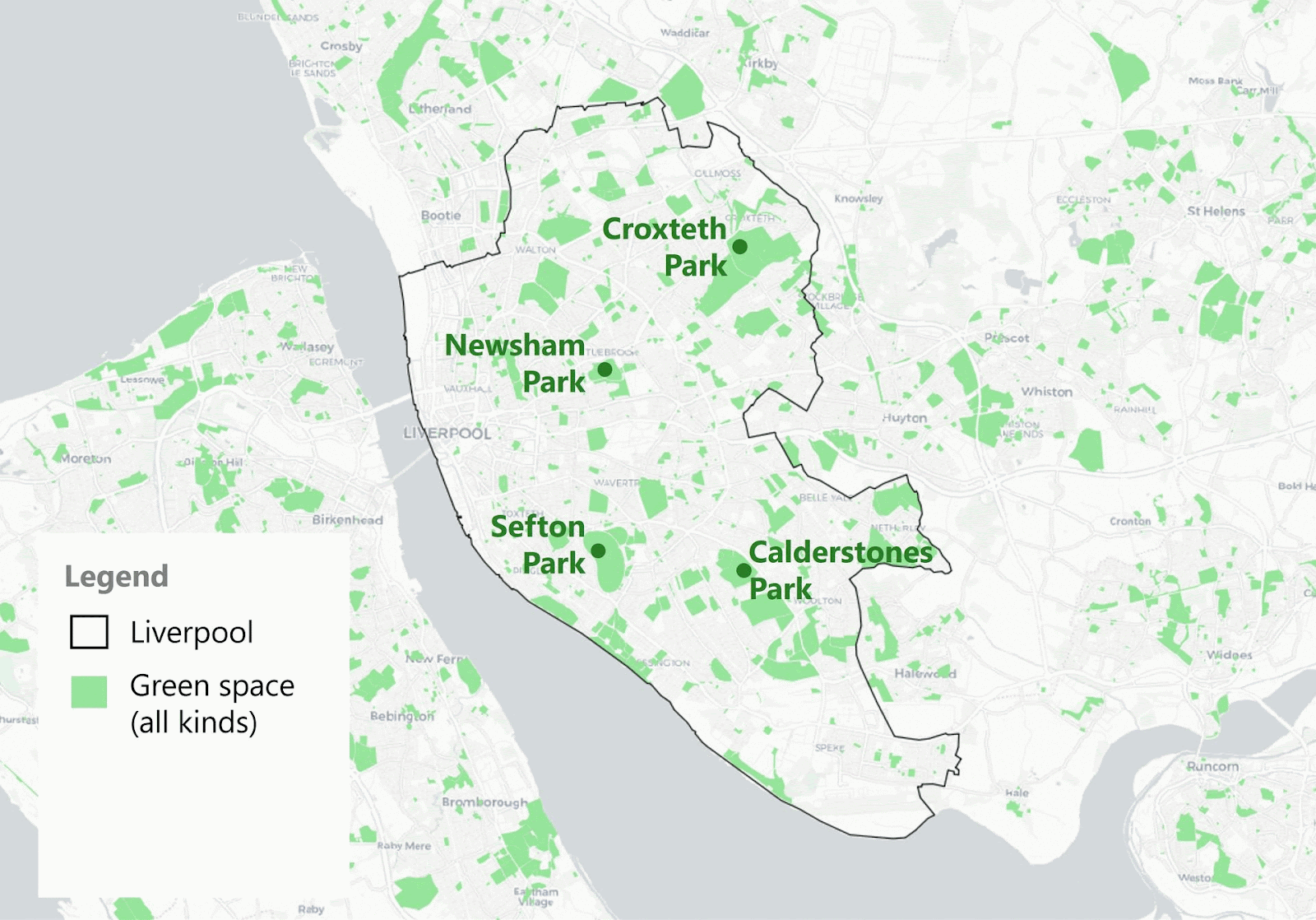
The biggest public park, by far, is Croxteth Park, at 224 hectares. After that, it’s Sefton Park (96 hectares). Newsham Park and Calderstones Park are the next two biggest, but they’re a fair bit smaller again (around 40 hectares each).
Does size actually matter?
In short — yes. In a bigger park it’s possible to get a much bigger positive boost to wellbeing than a small patch of grass on the side of a road. For people to feel the freedom green spaces can provide they need to be able to properly exercise and explore.
Natural England, a government advisory body, has put some numbers on this. Their Green Infrastructure Standards set the benchmark of “good” access to green space as where residents have:
- A “neighbourhood” green space of more than 10 hectares within 1km of their home AND;
- Either a “doorstep” green space of more than 0.5 hectares within 200 metres of their home, or a “local” green space of more than 2 hectares within 300 metres of their home.
It sounds complicated, but the idea is fairly intuitive. People need a proper space to really stretch the legs in. They’ll be willing to travel a bit further to get there, but it should still be within a kilometre, i.e. easily walkable. At the same time, they should also have a smaller green space nearer to home to pop out to for a quick hit of green calm.
Where has this access?
There are 24 of these larger “neighbourhood” green spaces in Liverpool, most of which are in the south of the city. As well as some of the parks named above there are spots like Princes Park and Childwall Woods.
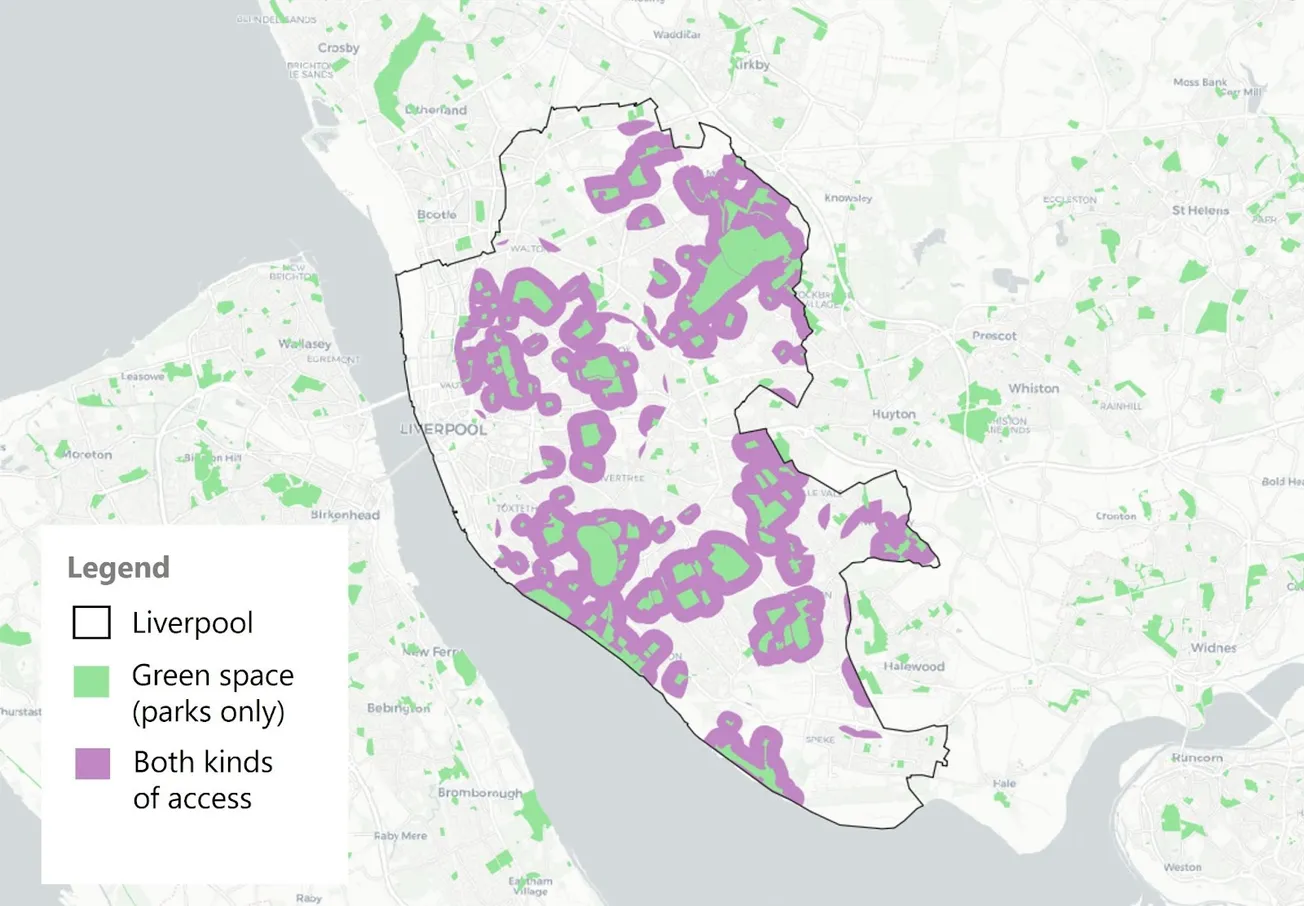
When we put both criteria on the map, it turns out that less than half (43%) of the city enjoys what Natural England would describe as “good” access to green space.
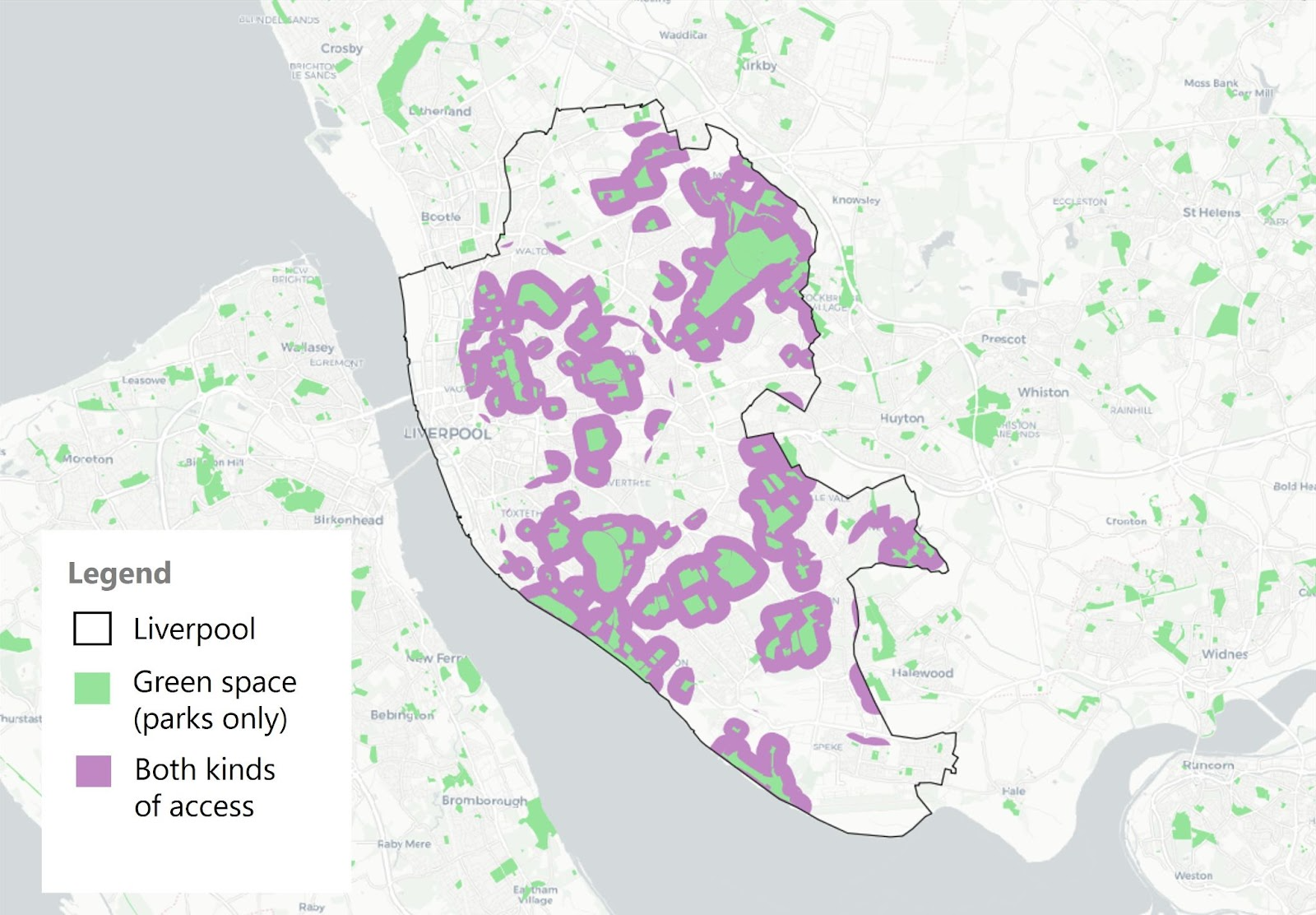
There are some clusters where this good green space access is common — up in the north east, around Everton (near Stanley Park and Brow Side Gardens), and the area around Wavertree and Calderstones.
We can also add on to the map the areas that meet one, but not both, of Natural England’s criteria.
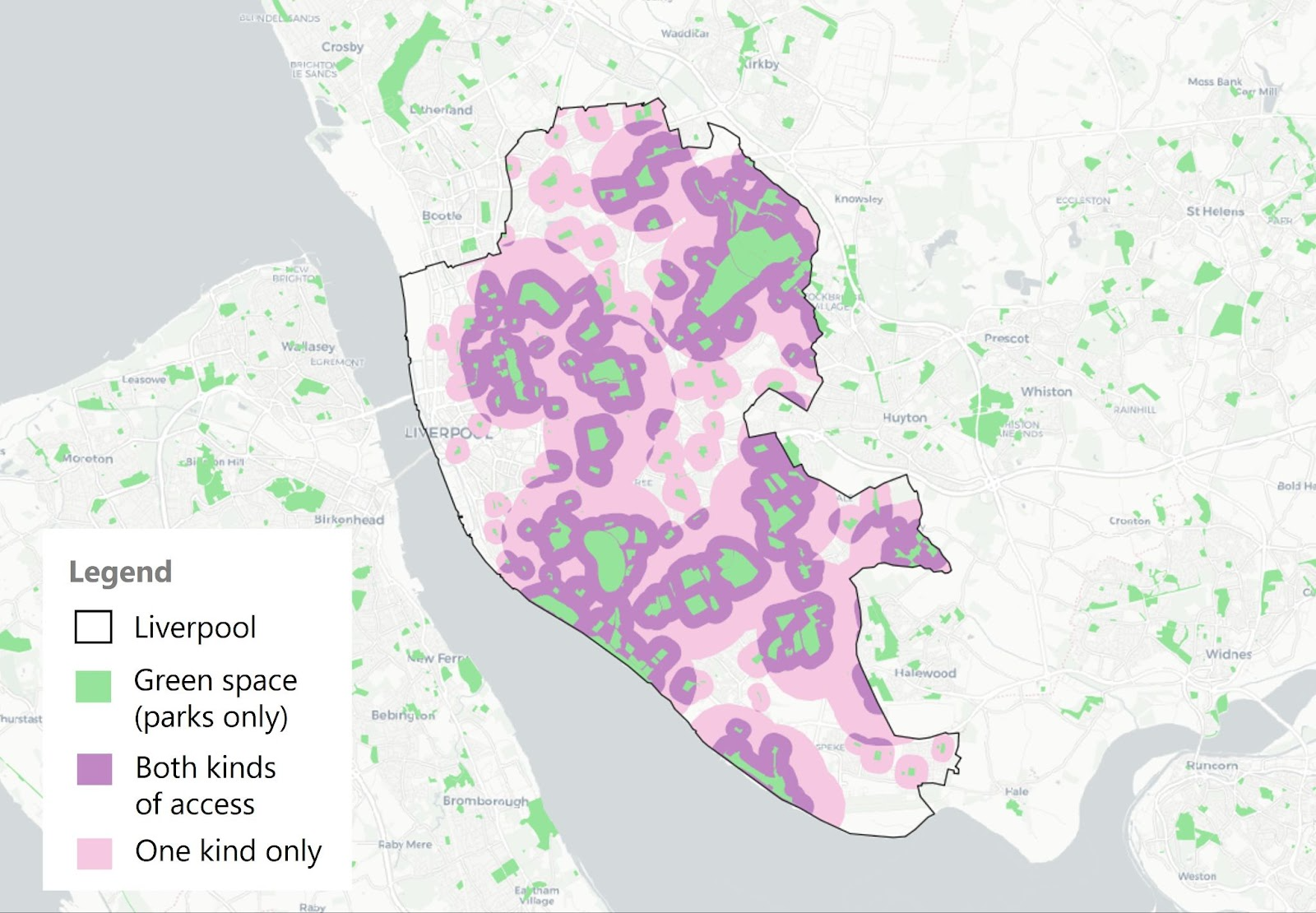
While most of the rest has access to either the neighbourhood or a doorstep/local green space, a fifth of the whole city has neither form of green space access. These issues are especially acute along the docks, the city centre and parts of Speke and Garston, as well as patches in the north like Norris Green.
As Lucy Williams, an independent councillor for Garston, points out, it is largely working class people in more economically deprived areas that are affected by a lack of green space. “We see really high levels of antisocial behavior in Garston, and there is a direct link to the lack of green space,” she explains, noting that much of the land available in the village has been used for housing developments, leaving little space for parks or amenities. “So now there's nowhere for the kids to congregate,” she says, “there's nothing for them to do”.
What can we do to bring more green into the city centre and other areas?
If we look at a handful of our neighbouring cities, it is possible to successfully introduce more green spaces into densely populated areas, and combat issues like antisocial behaviour and mental health problems. Take Mayfield Park in Manchester, for example. As the city’s first new park in over 100 years, the space has a diverse mix of plant and tree species to facilitate carbon capture. There’s a variety of spaces within the park, including children’s play areas, lawn spaces for events, a quiet zone and a wildscape for biodiversity. On top of this, since June 2023 the park has been smoke free, with even vaping banned from the premises to facilitate cleaner air. As a result, Mayfield Park has been deemed to be "leading the way" in urban regeneration, and last year won the prestigious Green Flag Award for parks and green spaces.
Over in Sheffield, a similar park has been created as part of a wider project to transform Sheffield’s city centre. Pound’s Park was previously used by the South Yorkshire Fire Service as their central headquarters before being transformed into a green space in 2023.
While Liverpool does have a number of longer term projects to create green spaces (Liverpool Waters includes a large park but will not be complete until 2041 at the earliest), it is clear the city would benefit from the introduction of another accessible green space sooner rather than later. However, as councillor Williams pointed out, there is an acute need for social and affordable housing in the city, and much of the land available for the development of green spaces has been earmarked for residential use.
However, this doesn’t mean all hope is lost. Instead, we can keep in mind that even small changes provide benefits to communities. Across the water in Toronto, a local target of reaching 40% tree canopy cover has been adopted, using the city council’s ownership of pavements to drive up the number of trees lining streets. As a result, the air is cleaner, and greenery populates most neighbourhoods.
When it comes to funding projects like this, just three months ago we published a piece outlining how the city had over £12 million of section 106 compensation — money allocated to local areas to improve amenities and green spaces — that is yet to be spent. As the council begins working through the backlog in order to get section 106 projects underway, investing in small-scale green spaces and improvements throughout the city could go a long way in supporting the wellbeing of residents.
What do you think about the access to green spaces in Liverpool? Is there anywhere you think could be transformed? Let us know in the comments.
Comments
Latest
The Post in Wonderland
How the National Bank became housing’s biggest headache
The one rule making Liverpool uglier
Liverpool vs UKIP: Round 2
Less than half of Liverpool has good access to green space. How can we fix it?
The Post looks to neighbouring cities to find out how we can benefit from better access to nature