

Is the University of Liverpool’s new campus in India a money grab?

The arse has fallen out of Liverpool’s foreign market. Now they’ve got a new arm in Bengaluru
Whitefield was built to look like England. It sits on the edge of Bengaluru, a city that’s been dubbed the "Silicon Valley of India". It was founded in the late 19th century as a settlement for Anglo-Indians: people of mixed European and Indian descent, who were largely excluded from the colonial establishment. Two roads bracketed a village green, with an Anglican church, a social club, and an inn that locals say hosted Winston Churchill.
Even now, nestled in the burgeoning sprawl of tech parks and high-rises, there are two concentric roads. A short drive from the green, the University of Liverpool is finishing a new campus. Its first students will arrive in Whitefield this September.
“Let’s start colonialism over again … for fuck’s sake,” a former Liverpool academic tells me. “These are vanity projects used to extract money and resources,” says another.
A spokesperson from the University of Liverpool tells me that the Indian government “invited overseas universities in order to build capacity in delivering higher education,” with the backing of the regional government in Karnataka and local employers.
Some will argue that this is a decision rooted in pragmatism: Liverpool’s most prestigious university launching a campus in the world’s fastest-growing education market. But there are doubts closer to home.
‘This is not just the University of Liverpool in India’
Earlier this month, David Willetts – the former Conservative universities minister – told the Guardian that the ongoing higher education financial crisis risked universities “going under.”
The maths behind the crisis is quite simple. Domestic fees have been capped way below inflation for a decade, while international fees move with the market. With costs soaring, international fees in the UK soared above the domestic rate – up to £30,000 in some institutions – in an attempt to fill the gap. Overseas universities are becoming more competitive, and the government has introduced new obstacles for student dependents (that is, a student’s partner or children) to gain visas.
Quite predictably, then, international intakes are shrinking and institutions are contracting fast. The University of Liverpool has been no exception.
The Foundation Building stands halfway up Brownlow Hill. It’s an office block dwarfed by the Waterhouse clock tower of the Victoria Gallery – the gothic building whose scarlet exterior gave birth to the term “red brick” university. In July 2024, the University of Liverpool's Council met in the Derby Suite, five storeys up in the Foundation Building. The Director of Finance gave a solemn report.
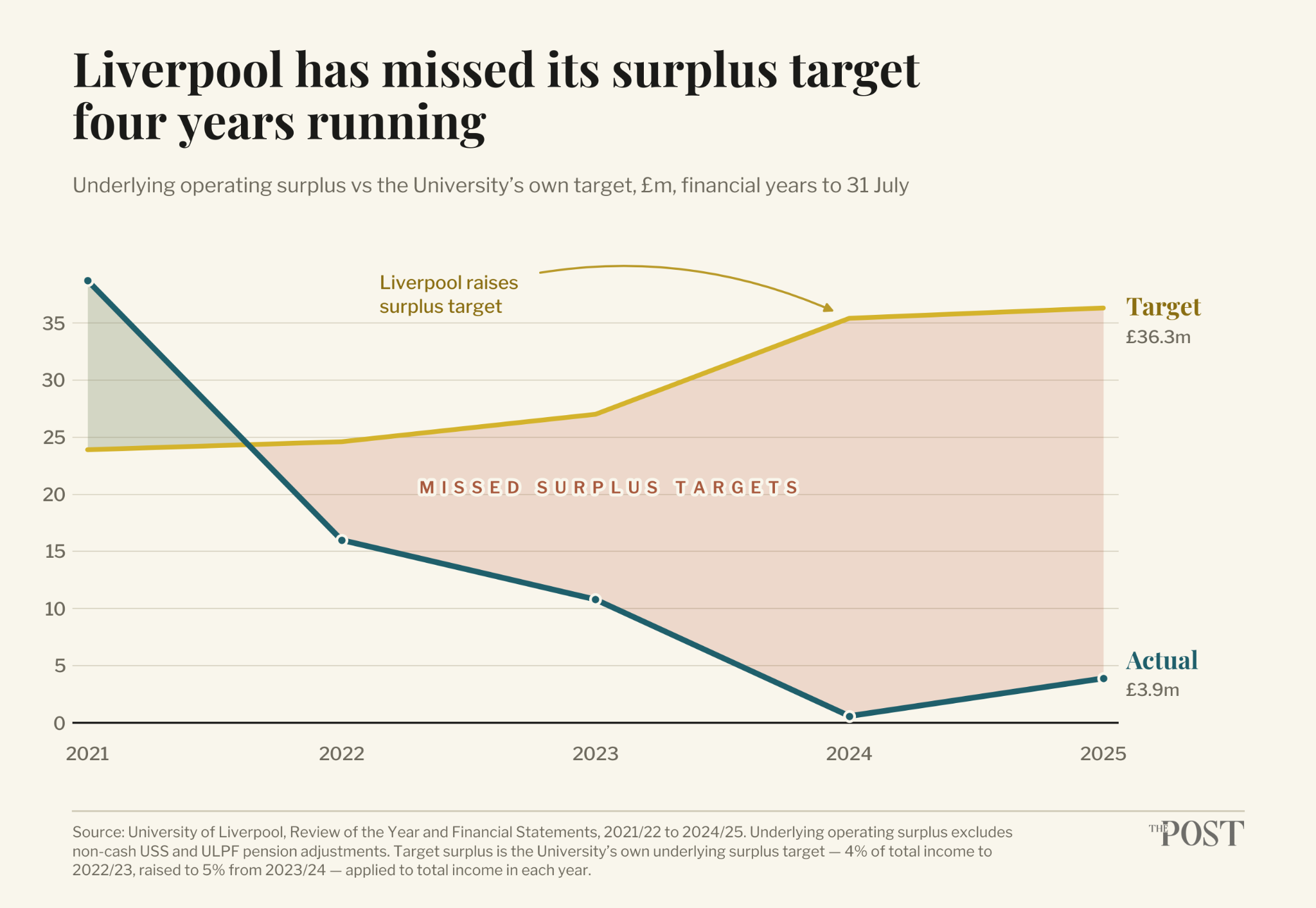
As it stood, the university would close the year £13m below plan, due to a shortfall in overseas tuition fees and a staff bill it could no longer manage. The risk of deficit, Council was told, was high. "The current operating surplus was too low and could cause significant issues if not addressed," Council noted.
All staff with two years of service were offered a voluntary redundancy package (the university prefers to call it a “Leavers scheme”), where staff could take up to 12 months’ salary, with a deadline for applications in April 2025.
In May 2025, when the University of Liverpool’s Council met again in the Derby Suite, they reported that the Voluntary Leavers Scheme was “progressing well” – the University doesn’t publish the details, but a source at the UCU puts says the number of lost staff is in the hundreds.
The university’s efforts to avoid financial ruin had taken on a name of its own: the Recovery Plan. The Voluntary Leavers Scheme was “progressing well”, but the Recovery Plan would need to go further to claw back the surplus. The Council set its new targets: recruit more international students, and build more campuses abroad.
The next item in the meeting was India. According to the meeting minutes, Professor Tariq Ali, Pro-Vice-Chancellor for Global Engagement and Partnerships, had come to tell the Council that approval had arrived from Delhi. Announcements would follow the next week. Excellent news, Council recorded, and thanked him.
When I asked Professor Ali what the campus was for, he did not start with money. "This is not just the University of Liverpool in India," Ali said. "It's Liverpool in India.” He talked about bridges: research partnerships predating the project, an incubator to send Indian start-ups towards Liverpool, and Steve Rotheram flying out in October.
The financial case, he said, was "absolutely important, but it's not the only thing." This point — that the university wasn’t primarily motivated by money — might be easier to take at face value if Liverpool were doing this alone, or unprompted. Nine British universities have committed to ventures in India in the last year – at a time when a shortfall of international students entering the sector is pushing universities towards new revenue streams.
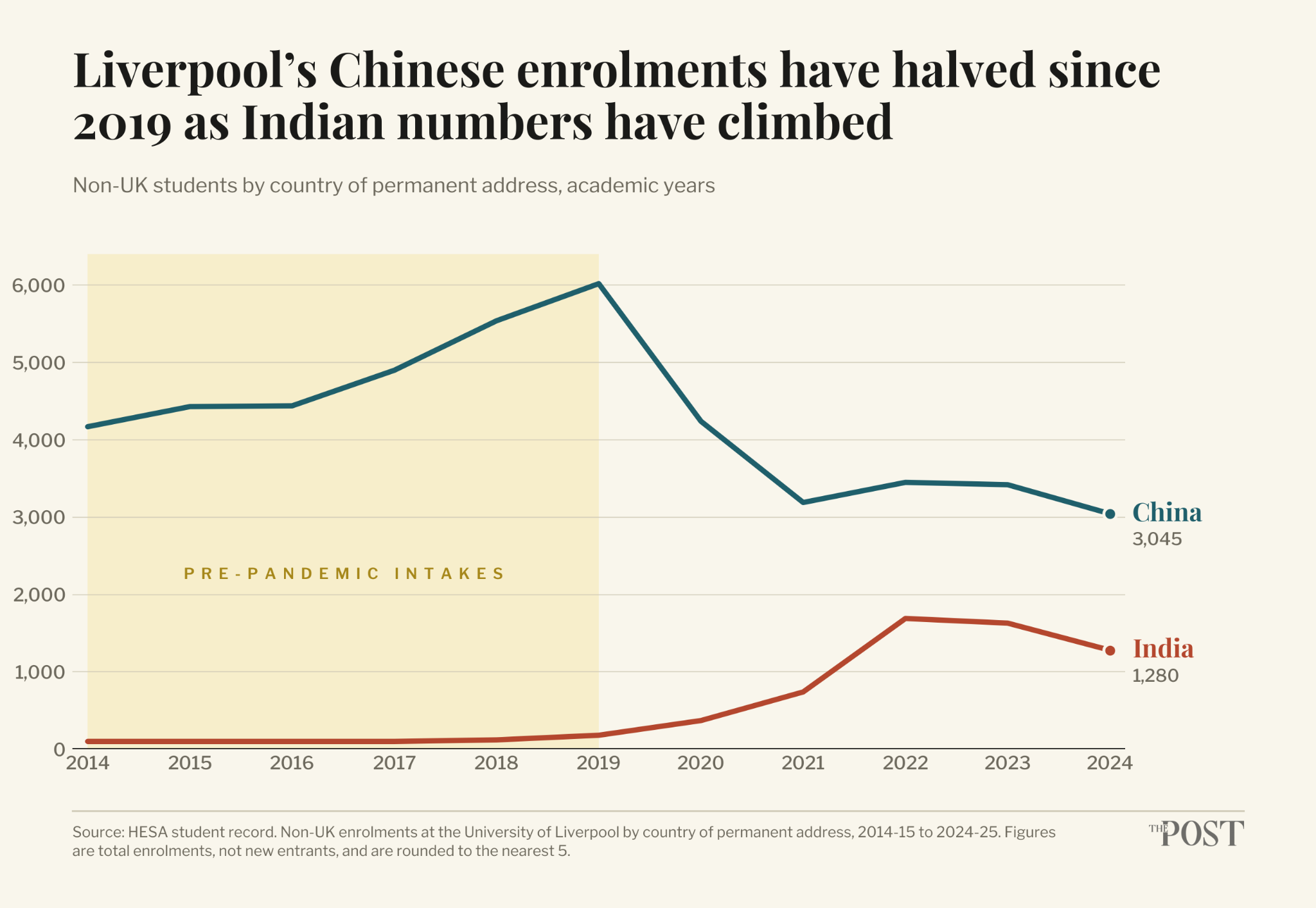
The pandemic mostly burst the bubble of Chinese international fee-paying, as the student numbers tumbled by nearly half and never recovered. Indian recruitment grew, but not enough.
Setting up abroad is good business practice, Ali says. “You would not do this altruistically anywhere in the world, never mind India or wherever else.” Some of the spell of all that talk of transnational bridges fades.
With campuses abroad, a student who once paid an international fee in Liverpool now pays a lower local rate, but is taught at much lower costs. An entry-level academic on India’s national pay scale earns about £6,000 a year, and a full professor at £29,000. In Liverpool, a lecturer starts near £38,000 and a professor upwards of £70,000, with employer pension contributions and National Insurance on top of both.
More importantly, Liverpool doesn’t appear to have paid for any of it.
‘The ambition is to get to 10,000 students’
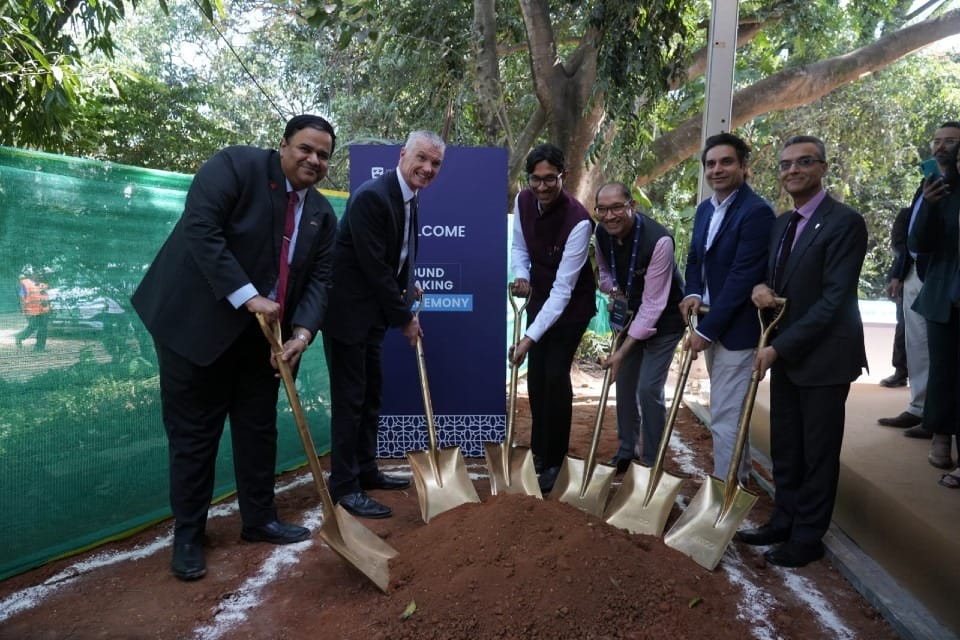
At the Whitefield groundbreaking ceremony, two men to the right of Liverpool Vice Chancellor Tim Jones inched golden shovels into a fresh mound of red earth. The content of the press release gave few clues as to who they were.
One of the pair, Ashwin Damera, is the CEO of edtech group Emeritus, which announced partnerships with seven British universities in January for campuses in Mumbai, Bengaluru and Gurugram. The other, Atul Khosla, joined the boards of four of those ventures: Liverpool, Bristol, York and Aberdeen. Khosla joined them all in the same week last November – he has since left.
"They put all the money in," Ali says. "It financially completely de-risked it for the university." Emeritus funding has covered all infrastructure and operational costs in Bengaluru, and will continue to do so as the University moves into ordinary business."We're in it with them for the long term. They will still be partners in ten years."
"I can't go into the commercials," Ali said, but confirmed there is a revenue share, and that money will come back to the UK.
Council minutes record that negotiations covered "return on investment for each party and exit arrangements." Two paragraphs of those minutes are withheld from the public record, both redacted for commercial interest. What Emeritus gets has never been stated by either side.
What Liverpool gets is easier to estimate. Eight degree programmes in the first year for 3,000 students at the interim site — a converted glass factory on a 90-acre plot in Whitefield, which Ali notes with some pleasure recalls St Helens. A permanent campus in a few years. And then, he says, "the ambition is to get to 10,000 students."
“A joint venture does not in itself transfer academic authority,” Professor Vangelis Tsiligkiris, a lecturer in transnational education at Nottingham Trent University, tells me. “However, the research shows that there is a tension of priorities between private partners and awarding institutions.” In other words, the edtech partner is driven by commercial goals, while the university is driven by academic ones.
Robust monitoring and evaluation solves this. Where this is weak, Tsiligkrisi warns, “an institutional risk becomes a sector level one.”
A chequered past
Liverpool isn’t just a name on the door, Ali tells me. The monitoring and evaluation, it seems, will be administered from home with the university’s “complete oversight.”
The University has some background in this type of arrangement. Between 2013 and 2019, it operated a satellite campus in London designed to capture working professionals and international students based in the capital.
Back in 2006, it opened Xi'an Jiaotong-Liverpool University (or XJTLU) in Suzhou, China – jointly owned by the University of Liverpool with Xi'an Jiaotong University. It now teaches around 25,000 students across more than 100 degree programmes.
An investigation by Times Higher Education found former staff raising concerns about class sizes, students' English, and how little they saw of Liverpool faculty. Another described “too much quality control”. The report records seminar groups packed of up to 100 students and some fourth-years unable to work in English, which, the report says, “suggests they never should have been admitted in the first place." A University spokesperson tells me that the XJTLU scheme is “widely regarded as one of the most successful transnational education institutions.” (On checking, I was unable to corroborate this.)
I asked Ali whether the university had taken on findings from the XJTLU investigation. "I can't remember the article you're referring to," he said. The criticism, as he recalled it, "was a bit unwarranted and was a bit hyperbolic."
Is the price right?
In 2025, the state of Karnataka – of which Bengaluru is the capital – commissioned a comprehensive review of its education system. In amidst three volumes and 2,000 pages of recommendations, the chairman made the firm point that the commission is “not in favour of foreign universities opening their campuses” in the state. “It will not be accessible for the poor and it is very expensive.”
A month later, the state’s higher education minister was in London in talks with British university vice-chancellors.
But the All India Democratic Students' Organisation condemned the plans. The state universities were already short of teachers and basic infrastructure, the branch secretary said. Courting foreign universities, they said, was a “betrayal of trust”, and a grim step towards the commercialisation of Indian education.
An academic from the AADTA – an Indian teachers association – condemned the plans in stronger words: ”These educational East India Companies will try to plunder the vast educational sector.”
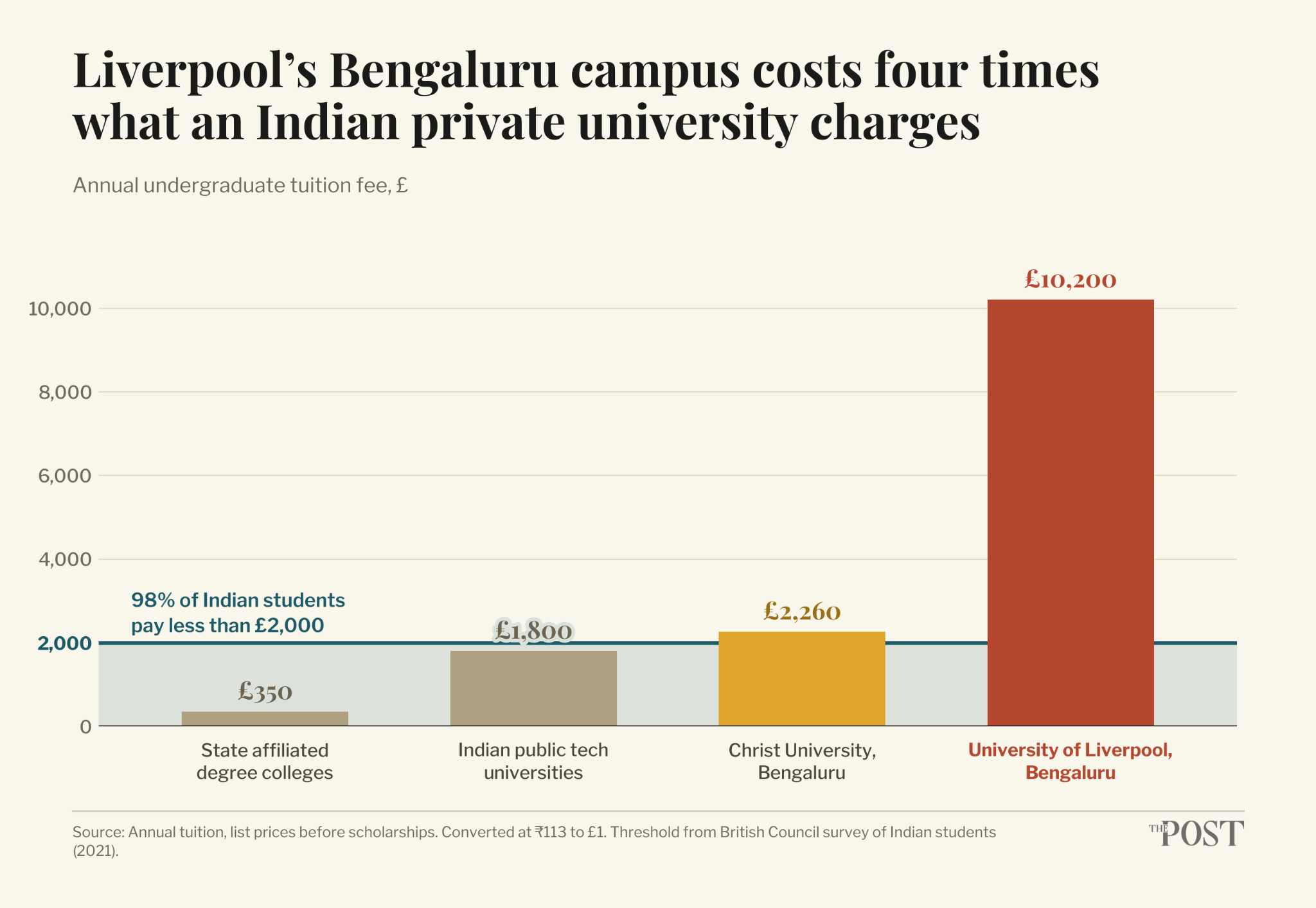
The prospectus prices a Liverpool degree in Bengaluru at ₹11,50,000 a year: that is, roughly equivalent to £10,000 per year. The masters programmes are closer to £13,000. Liverpool charges international undergraduates upwards of £25,000 in the UK. Against that, Bengaluru is cheap. But compared to Indian alternatives — where the average tuition fee for the year costs less than £1,000 — it’s extortionate.
Even an Indian student preparing to start at Bengaluru seems ambivalent. "I realised I really want to get into research and do a PhD abroad," he tells me. A Liverpool master's, taken in Bengaluru, is the pragmatic but expensive path towards that.
He doesn’t buy all the brand stuff, though. “Liverpool is a member of the Russell Group, but that’s just a marketing trick,” he says. Nor does he think the degree is worth what it costs, if the plan is to stay in India. For those wanting to use the degree to get back into the Indian job market, it’s “too overpriced.”
Between a rock and a hard place
“The British higher education system has priced itself out of the global marketplace. The only people that can afford it are the elites, or those on scholarships,” Adam Habib, the Vice-Chancellor at the School of African and Oriental Studies (better known as SOAS) tells me. Vice-Chancellors are normally a studiously on-message bunch. Habib is, by his own admission, an outlier – at a conference earlier this year, he called the deficit-hit universities going abroad “deluded.” When we chat, he’s taken a more sanitised approach.
“The institutions that are running at a loss in the UK and hoping for easy profits and quick profits in India have not sufficiently recognised how complex an environment India is.”
Habib thinks these projects are risky even on their stated mission of global educational development – or, the bridge-building Professor Ali mentioned. “They tend to largely weaken local institutions, apart from under exceptional conditions” (when I put this to the University’s press team, they said they have no intention of doing this, given their extensive connection with local Indian universities).
Habib is eager to stress that he does not blame any of his colleagues in university leadership. In investigating this story, I too haven’t found evidence of ill-intent. It is even questionable whether the university has chosen this path at all. They seem almost commercially obliged to make this move, with few other options for making up the shortfall in overseas tuition fees.
For years, Whitehall has been urging British universities to look abroad. The government employs Sir Steve Smith – a quasi-mythical industry figure as the garishly named International Education Champion, who identified India as a priority location back in 2021, and worked to open the market to foreign campuses. The government’s own target requires an extra £5bn in annual education exports by 2030. Liverpool are part of a much bigger tide.
A former academic tells me that the University promises access to Liverpool-based academics without consulting the potential supervisors in advance – and, in fact, “the supervisors don't have the capacity." The University of Liverpool says that projects may be “co-supervised by an academic located at Liverpool where they have specific expertise relevant to the project”, though students will not be supervised solely by Liverpool-based staff.
Mark O’Brien – President of the Liverpool branch of the UCU – tells me that the voluntary redundancy scheme has hit capacity hard. “Many teams and professional areas are already depleted and under significant strain.”
From my discussions with academics, one thing seems clear: the University’s Indian campus will only provide UoL-level teaching if it’s guided, evaluated and steered sufficiently from its base. But the university’s cost saving measures appear to have eroded the possibility of providing meaningful oversight. Still, you can’t deny the university is making lemonade out of austerity lemons. The University lost £11m after a London branch campus shut down only seven years ago. This time, at least they didn’t pay for it.
Hello all. I hope you enjoyed today's weekend read. Sign up today for just £7 a month and you'll be contributing towards our continued mission to bring the best journalism to every nook and cranny of Merseyside and the Liverpool city region. Without being too big-headed, it's great to be part of a winning team: join us today and benefit from our full premium service.
If someone forwarded you this newsletter, click here to sign up to get quality local journalism in your inbox.
Comments
Latest
We campaigned, they listened. So why is the botanical garden still in trouble?
Flights of Fancy: the debunked Liverpool Airport migrant conspiracy
Are we finally getting the 'new Baltic Triangle'?
Send us your tips
Is the University of Liverpool’s new campus in India a money grab?
The arse has fallen out of Liverpool’s foreign market. Now they’ve got a new arm in Bengaluru