

Why is the Wirral the most depressed place in England?
Liverpool’s ‘Left Bank’ was meant to be having a renaissance. What’s gone wrong?
Dear readers — welcome to the return of Answers in The Post, the edition where you can tell us what to investigate and we burn shoeleather finding out. Future suggestions are welcome, either in the comments below or to editor@livpost.co.uk.
This week the topic is a blue one: depression. Over the summer, the House of Commons Library released data for the prevalence of 20 health conditions. As the Wirral Globe pointed out, when it came to the black dog, Birkenhead was the most depressed constituency in England. Also in the top three was Wallasey:
And if you break it down by neighbourhood, seven of the ten most depressed areas in the whole country are on the Wirral:
Why is the Wirral so melancholic? We sent Laurence around his home peninsula to find out what’s ailing the Mersey’s left bank.
But first: your regularly scheduled Post briefing.
Your Post briefing
Jimmy McGovern calls borstal staff lazy: Jimmy McGovern, the BAFTA-winning writer of such Liverpool-based classics as Hillsborough and Broken, says going into young offender institutions to research the latest series of his BBC drama Time left him with a poor impression. The creator of Cracker told North West Tonight that young offenders were "banged up 23 hours a day" so staff could "sit on their backsides all day". The Prison Officers' Association called criticism "unfair". The series will star David Tennant and Siobhan Finneran alongside younger actors.
Steve Rotheram knocks St Helens’ council leader. Last week, St Helens council's Reform leader George Woodward said support would be withdrawn for Black History Month, calling the celebration “racist”, “divisive”, “subversive”, and “woke.” Metro mayor Steve Rotheram has responded, calling the decision "the worst dog whistle politics". Rotheram told Radio Merseyside: "I just don't get it, what is the problem with recognising the part that different cultures have played in the melting pot that is the UK population?" After saying this week that the "jury was out" on whether St Helens would be marking Holocaust Memorial day, Woodward has since clarified that it will be.
And some good news: Southport Pier’s restoration is going well. Work to restore the Grade II-listed pier is “ahead of schedule” according to its project manager. The Victorian tourist attraction has been closed since 2022 due to safety concerns, but is being restored with £20m from government coffers. Southport’s is the second-longest pier in Great Britain and the oldest surviving iron/metal pleasure pier in the country.
Why is the Wirral so depressed?
Where is this data from?
According to the Commons library, the information is based on analysis of 2024/25 data from England’s GP practices published by NHS Digital. So, it’s not cutting edge data — but it is the most up-to-date available.
The data is collated as part of the NHS’s Quality and Outcomes Framework (or QOF). This is a way of measuring GP practice achievement against clinical, public health, and quality improvement standards.
To get a handle on the topic, I speak to Ewan Tomeny, Green councillor for Birkenhead (#1 most depressed constituency in England in our first table) and Tranmere (#5 most depressed neighbourhood in our second table).
“It’s really bleak,” Tomeny says, looking at the wider health data on his own computer. “We are not doing well.”
Remarkably, Tomeny is also a post-doc research assistant at the Liverpool School of Tropical Medicine with a background in public health and global health economics, so perhaps uniquely placed to help us understand this information and how it pertains to Merseyside.
“The first thing I’d say is that this is a crude way of collecting data,” Tomeny says over the phone. Usually, he explains, the optimal way of accumulating information about a health crisis would be to stop and test people; this has been done on a more “head count” basis, going by GP diagnoses.
“It could be that our GPs’ diagnostics are more finely attuned for depression,” Tomeny explains. In other words, constituencies could be just as depressed, but they either aren’t seeking medical attention for it or aren’t receiving a diagnosis.
As ever, then, there’s a limit to what data can and can’t tell us. But perhaps by bringing in other information, a clearer picture may emerge.
Is there an upwards trend?
Yes — across the country. According to NHS England, the 2024/25 data showed the highest QOF recorded prevalence rates — that is, the proportion of the population who have a specific condition at a given time — for hypertension (15.2%), obesity (13.9%) and depression (14.3%). And on these measures, Birkenhead and Wallasey are doing even worse than the national records:
Physical health and depression are linked: as Tomeny says, “patients who are physically unfit become mentally unwell, and patients who are mentally unwell become physically unwell.”
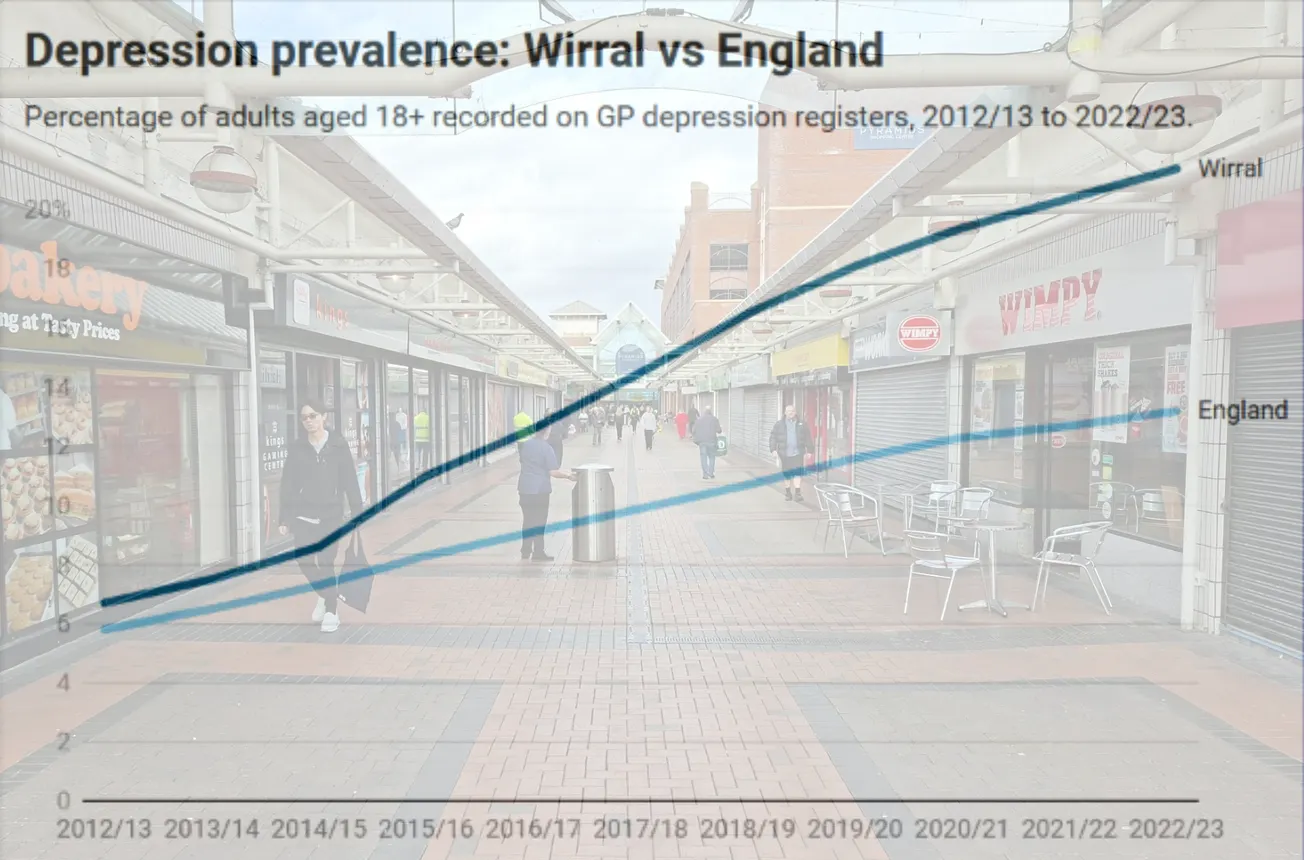
And when it comes to depression prevalence, the Wirral is not just out-pacing England, but at an increasing rate. Take a look at this chart:
Liverpool deserves great journalism. You can help make it happen.
You're halfway there, the rest of the story is behind this paywall. Join the Post for full access to local news that matters, just £7/month.
SubscribeAlready have an account? Sign In
Latest
Why is the Wirral the most depressed place in England?
I wasn't the female Brian Epstein
'Woke' and 'subversive': St Helens to abandon Black History Month, council leader says
A decade of harassment
Why is the Wirral the most depressed place in England?
Liverpool’s ‘Left Bank’ was meant to be having a renaissance. What’s gone wrong?