

The Post in Wonderland
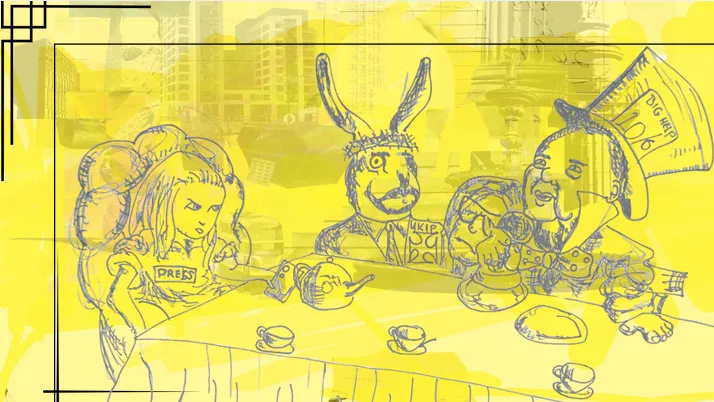
Following the white rabbit
Some years ago, when I still toiled daily in the towers of the financial district, I was sitting on a bench eating a sandwich in Bixteth Street gardens. I will admit to feeling a little drowsy; back then an occupational hazard after a morning of looking at spreadsheets and Linux systems. But just before I could slip into an even deeper coma than that of my day-to-day life, a white rabbit with pink eyes ran close by me.
There was nothing very remarkable about it — back then, it was quite common to see rabbits frolicking in the shadow of the Cotton Exchange. What was unusual was when the rabbit stopped, pulled a Galaxy S7 from its Moss Bros waistcoat, and said aloud, "Oh dear! Oh dear! I shall be too late!"
Electing to follow the sartorial coney, I left my sandwich for the seagulls and set off in hot pursuit. I soon found myself tumbling down a pothole into a veritable wonderland of confusing characters and highly unnerving incidents.
There was the Mad Blagger, a former councillor who’d siphoned off millions from a housing charity; the Dormouse, his accomplice who almost fell asleep at the few council meetings she did turn up to; Tweedlesteve and Tweedleandee, who implausibly professed to run two metropolitan areas; the Joebberwock, a frumious city mayor who guaranteed something called “best value”; the Caterpillar they used to erect the ugliest buildings imaginable; the March Blert, a far-right irritant attempting multiple processions through the city centre; and the Cheshire Cat — or, more accurately, the Cheshire and Warrington Combined Authority Cat. (I also pleasantly recall Pete the Lizard, an enterprising Radio City host.)
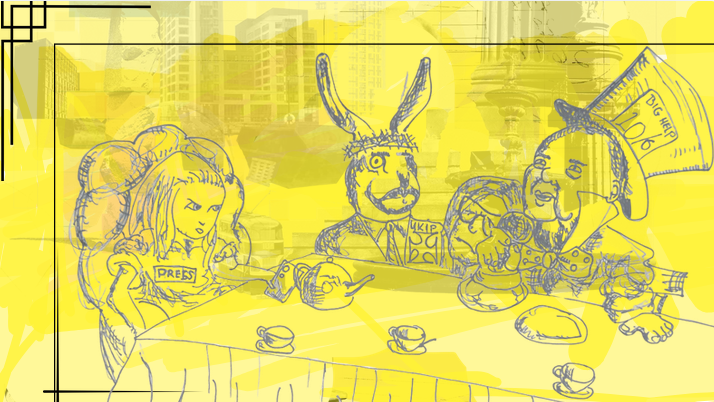
As you can imagine, making sense of this quagmire of council meetings where it’s always 6pm, “caucus races” that went round in circles; and trials that drag on in perpetuity was nigh-impossible.
Needing a guide, I reached for the local paper — which had sadly devolved into a hodgepodge of misspelled and ungrammatical nonsense. It began to flap all by itself like some black-and-white-printed bird, snapping “Read Me!” in spite of its unnavigable layout.
Just when I began to theorise that I may actually have been asleep after all, I was recommended a far superior alternative.
The Liverpool Post, I was told, was a high quality news website promising long-form journalism and serious investigative reporting. It wouldn’t try to bait you into clicks with suckering headlines or pester you with adverts. Much like the white rabbit, it wasn’t always first to a scene, but The Post would always deliver the best writing on any given subject. It wasn’t a fairytale for overgrown children, but a serious — if sometimes irreverent — news source for grown-ups.
Long before I wrote for it myself, The Post helped me make sense of the slithy toves of Merseyside and the Liverpool City Region. Villains were unmasked; financial misdoings uncovered; the complex cultural scene unpicked. I became a subscriber and received the very best journalistic copy in my inbox several days a week.
Which led me to a paradox that would have delighted Lewis Carroll himself. If The Post was such high quality, but didn’t deploy clickbait or laptop-crashing ads, how did it pay for itself and its small but dedicated team of professional writers? Was this some kind of devious Red Queen situation, where these poor journalists must produce better and faster content just to stay in the same place?
The truth is that The Post is funded by its readers. We appreciate each and every one of our free subscribers, and we’re always on the lookout for more. But the truth is, if you don’t pay for The Post you’re missing out on our very best stories — the ones that take us months and really bring order and method to the madness around us.
The good news is that if you sign up today, you’ll pay only £1 a week for the first three months. That’s for some of the best journalism, op-eds, culture writing and deep dives anywhere in the country, never mind Merseyside.
Imagine what a better-funded Post could do. A full team of researchers, writers, editors and proof-readers. A city desk, a whole culture section, a business column, maybe even a sports news team. Combine those resources with our reader-first approach and maybe the next little city park won’t get bulldozed or the story of those affected by monied interests can be told more often. That’s the vision I have for The Post: a bustling office working for the people of Merseyside. You’ll never convince me that’s just a daydream.
In a time when journalism is destroyed by cuts or compromised by corporate interests, we think a project like The Post is more vital than ever. Help us make sense of our wonderful city region and sign up today.
Comments
Latest
The Post in Wonderland
How the National Bank became housing’s biggest headache
The one rule making Liverpool uglier
Liverpool vs UKIP: Round 2
The Post in Wonderland
Following the white rabbit