

'The church has lost its way a bit': A vicar who wants change in this world, not the next
After 40 years in inner-city ministries, Neville Black talks homophobia, stolen toffee tins and religious conversion
Dear members — Neville Black was always destined to be an inner city vicar. A vicar of the frontlines, so to speak, not one happy to enjoy a quiet life of ease in a pastoral parish. Born not long before the turn of war, he grew up in Bootle, where for a brief window of 1941 the bombs fell as intensely as anywhere outside of London. Later he came to wonder how this strange early life, along with the loss of his father at the age of three, came to inform his faith. Now in his 80s, Neville has written the story of his life: 40 Years in Liverpool’s Inner City. We went along to meet him.
Your Post briefing
James White, a Manchester United fan who wore a top with the number 97 and the words “not enough” in reference to the Hillsborough disaster, has pleaded guilty to displaying threatening or abusive writing likely to cause harassment, alarm or distress. White — who wore the shirt at the FA Cup final earlier this month — was banned from all football games in the UK for four years and fined £1000. Manchester United have also awarded him an indefinite ban. The club issued a statement saying that “mockery of Hillsborough and other football tragedies is completely unacceptable and the club will continue to support firm action to eradicate it from the game.”
New data has shown that Knowsley has the lowest female life expectancy in the country. According to Public Health England, women in the borough live for an average of 78.5 years, compared to the national average of 82.5 years. Moreover, the range of life expectancy even within Knowsley is vast, with women in wealthier areas like Prescot South living eight years longer than those in deprived ones like Northwood, reports the BBC. Higher levels of heart and respiratory disease and lung cancer were named as the leading causes of lower life expectancy, linked to preventable risk factors like smoking and alcohol. The dip — described by Knowsley Public Health Director Sarah McNulty as a “call to action” on health inequalities — was also noted to be within the context of Covid-19 in 2021 (the year the data was sourced from).
The Liverpool City Region has helped to fund the second series of Jimmy McGovern’s acclaimed prison drama Time. The first series, starring Sean Bean and Stephen Graham, was released in 2021 and depicted the brutality of life in a male prison for a man unused to such an environment. Bean won a BAFTA. The second series will switch to a female prison, and will draw from a fund created by the LCR to try and make Liverpool a hub for filming. Filming took place in Liverpool, Halton, Wirral and Knowsley, starring Jodie Whittaker and Bella Ramsey.
"The church has lost its way a bit." It's not something I'm expecting to hear from a former vicar, much less one who served for four decades in Liverpool. But Neville Black is a rare sort — anything but a company man, if a vicar can ever be described as a company man. He often talks critically of the church, not flippantly, but because he views its social role as vital but not something it always delivers on. “We’ve become more and more congregational," he explains, "but there is still considerable need out in our communities”. He even responds to a local group in his area starting a ‘prayer team’ as a waste of time. “Quite honestly I’m thinking: what good’s that gonna do?"
But we're getting ahead of ourselves. To understand Neville, you have to understand the context — what Holden Caulfield dubs "all that David Copperfield crap" in The Catcher in the Rye. Neville's upbringing, his childhood, his conversion.
So let’s start with 1939 — an important year for Neville as well as the rest of the world, because it was singularly horrible. In the summer his father died of tuberculosis. By early autumn, Europe was at war. Neville was only three.
Bootle, where he grew up, suffered badly during the Blitz. For eight nights in May 1941 it was one of the most intensely bombed places in the country; 1000 people were killed or injured, 80% of homes were damaged or destroyed. Whenever the sirens rang out his brother would scramble back from his girlfriend’s house in the family wagon, into the back of which the family — plus a handful of neighbours — would then climb, draped underneath a large tarpaulin sheet canopy. Then they would speed off to the safety of Huyton. The damage that lingers most pre-eminently in his mind though was that caused to Williamsons’ Toffee Works, which was gutted. Local children looted it and made off with tins of toffee. It was a strange time to be a child.
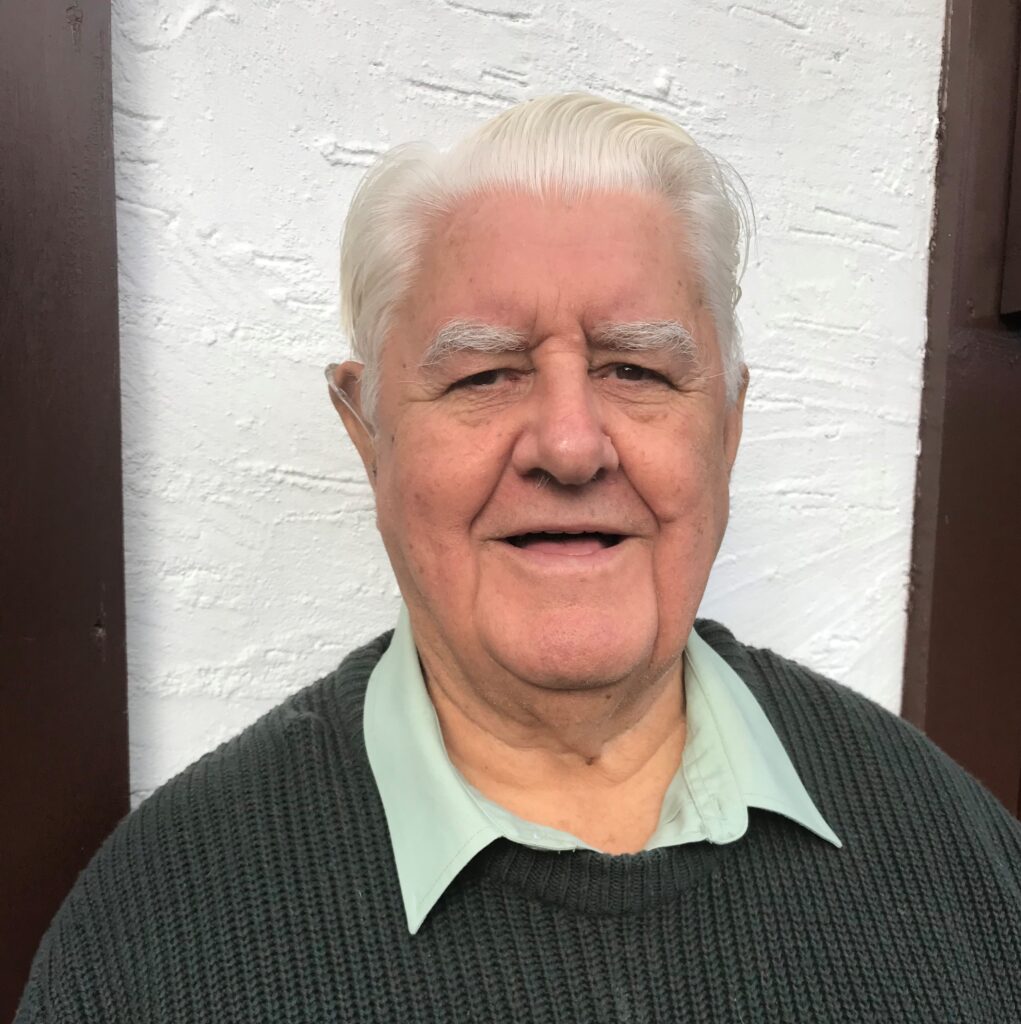
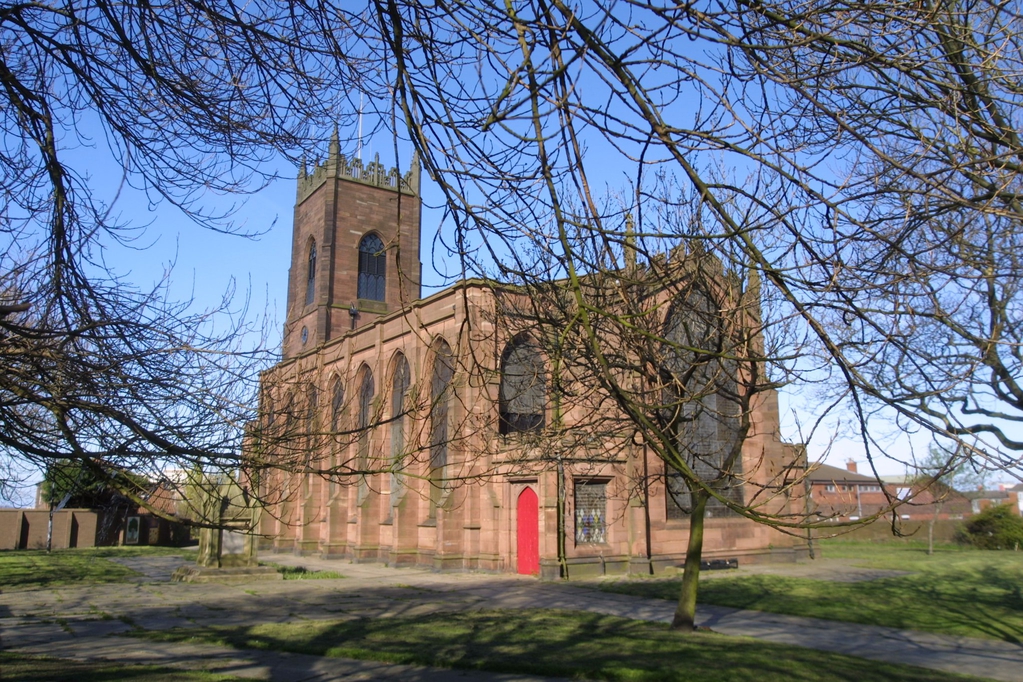
Neville was a rare sort of vicar. He retired in 2004 after serving four decades in inner-city ministries, spending much of that time in Everton at St Timothy’s and then St George’s (which boasts the status of being the world’s first iron church), later becoming Team Rector of St Luke in the City. Recently, Neville sat down and wrote out the story of his life, with a little help from a younger friend who “understands the technology stuff better than I do”. He called it 40 Years in Liverpool’s Inner City. The “inner city” element, he tells me, is crucial.
Living in Falkner Square as a young man in the early 60s with his wife, Val, he made his mind up about the life he wanted to lead. The grand Georgian properties that surrounded them were governed by Rachmanite-style landlordism, sometimes two to three families on a floor. The desperation was palpable, the living conditions sometimes horrific, overcrowded kitchens and makeshift toilets. But he fell in love with the inner city all the same. He realised then the type of person he would be: one in the thick of things. He describes it as a vocation — a kind of magnetic draw. When he was offered a curacy in Everton, it was perfect.
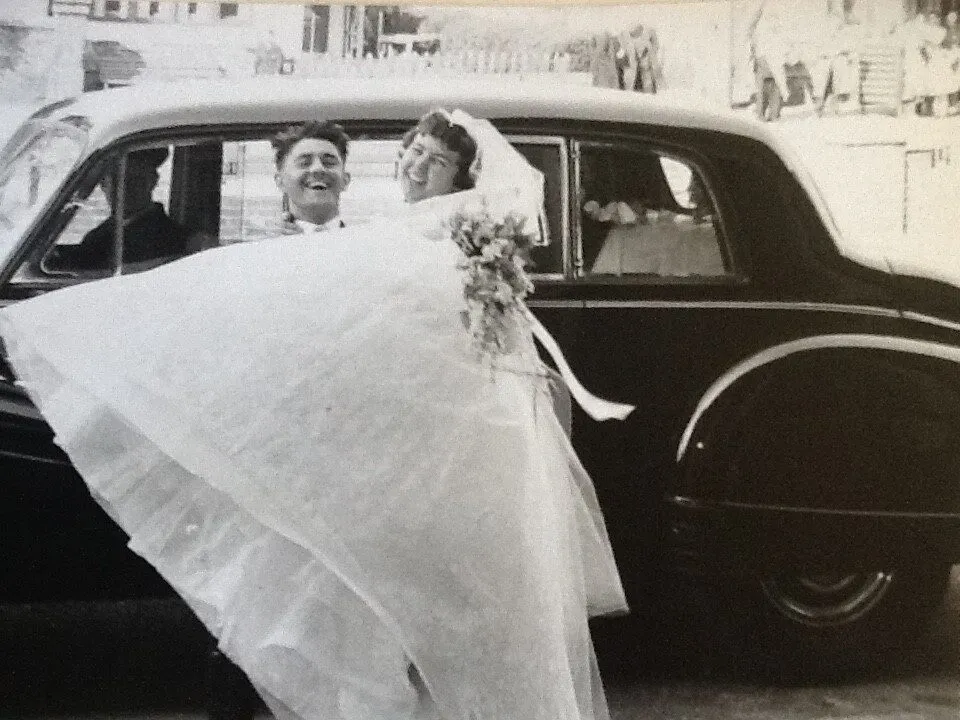
Neville’s religious conversion had come when he was 17. It was “overwhelmingly powerful”. He had first had contact with the church as a young child during the war when his mother had taken a job in a tobacconist as a shop assistant. She’d leave for work at 6:30am, and an “exceedingly kind” single mother down the road took on the role of taking him to school, and then to church. It planted a seed. His conversion would come just over a decade later though, on a date that seems etched into his psyche: Friday 3 January 1953. He had attended a prayer meeting at a church and found himself profoundly touched by the experience. Upon arriving home, he knelt beside his bed and underwent an experience that he struggles to find the right words for. In the book, he describes it as akin to “a blind person gaining the instant ability to read Braille,” and having “instant insight.”
When he arrived in Everton, Neville found a place undergoing monumental change. Slum clearance programmes were widespread. Large parts of Everton had been earmarked for demolition, other parts had already been demolished. When the demolition contractors went in and pulled up the floorboards, thieves followed soon after and went for the lead and copper pipes. Many people were left without water. He remembers attending community meetings that spilled over with people terrified that their families would be torn in half. “All these people were turning up asking: “Where’s my grandma gonna go?”
Aside from the clearances, other problems were many. If one kid every other year at the local school earned a scholarship, that was a success. “The community was strong,” he says. “But people did struggle”. Community is often a product of hardship, of course, but his task was to harness that, and to use the Bible in a way that made sense to people in the context of their immediate environments. He realised too, that the Bible alone wouldn’t be enough. His style became conversational, he ditched the pulpit.
He’s the sort of vicar to whom the job is social first. “The Church of England is a very good finishing school for middle-class life,” he tells me. “Working-class people learn how to fit into this dominant middle-class space”. His aim was to change that somehow, he talks with frustration about those in his congregation who joined the church from the community and then turned their backs on it.
It’s the overriding theme of his book, teasing out the tensions between the traditional elements of the church and his inner drive to create a place that felt open to its community. Even minor things underlined this; like the resistance of some in his congregation when he started putting on church bingo nights with a bar. “People need to be able to enjoy themselves,” he laughs.
Although not university-educated, in his book Neville writes about the personal research he carried out to inform his style. He talks about the linguistic theories of British sociologist Basil Bernstein, who charted the connections between manner of speech and social organisation. His theory was that speech carries its own aesthetic, and how it informs the ability of the individual to verbalise intent and to connect with a range of people.
In middle-class communities, Elaborated speech develops, in which the speaker picks and chooses from a range of options, giving them a universally competent language system that can adapt at ease to different social contexts. Restricted Speech — which develops more in working-class communities — is designed to retain good relations only within one's own community, and not to reach out beyond it. The language system is condensed and — as in the name — restrictive, often littered with parochialisms and non-verbal cues. Certain words can have multiple distinct meanings, and the intended meaning is hard to interpret for someone outside of that community. Neville cites “bastard” as an example. “In a working-class community that word could be followed by a hug or a punch on the nose.”
Why does all this matter? It matters because for a vicar, communication is everything. “It took me 10 years to learn that new stuff, I had to slop off all of the old stuff.” He realised how — for so many of his congregation — joining the church was steeped in social initiation, even down to the details; heavy industry-working men with no other need for a tie having to go out and buy one. The women needing a hat. His job was to smooth the transition.
There were other changes he had to implement too. He describes the “huge mental cruelty” directed at the gay men when he served in the RAF not long after leaving school. “They were treated appallingly”. He too, he says, harboured homophobic attitudes back then. He recalls that the CoE introduced a ‘peace’ to services in the early 70s, a sign of Christian love and conciliation often made through physical gesture. “I remember being hugged by a homosexual and I completely froze. You have to undergo your own process of change”. Change he did though, and later he would often challenge homophobia in his congregation. He regrets deeply the pain suffered by those he knew in the RAF earlier in his life. “They couldn’t possibly be open,” he says. “They would’ve been told they were wrong and that they had to learn to be chaste and a load of rubbish”.
And change didn’t always come easy either. His efforts to develop Ecumenical relations between different Christian groups in the 70s — by inviting Catholics into his CoE church in Everton, caused him to fall foul of the Orange Lodge. Leaflets went around north Liverpool calling him “the mark of the beast”. It didn’t phase him — over time he was able to do more and more to dangle a fig leaf across the divide, setting up festivals at St George’s which were attended by children from 12 local primary schools, Catholics and Protestants included.
Those were the big battles, the defining moments for Neville, but so much of his work, he says, is in the small details. Like the lunch clubs he set up for older church members, especially those who were windowed and needed social contact. Well after his retirement he kept these clubs going. The sum total of his work earned him an MBE.
Later in his life Neville began to re-evaluate the role played by the death of his father. His older siblings have clearer memories of their dad, but Neville, who was three at the time, only has flashes: little mental mirages — like one image of sitting on his father’s lap as his wagon was pulled down the road. In God he found a surrogate father, he thinks, but only in midlife was he able to understand that. “I think that was why my conversion felt so powerful,” he tells me.
Now in his 80s, he sees the world, and faith, a little differently. He’s become fascinated by Celtic theology, which prizes the dynamism of creation and original goodness over original sin. “Plants,” he says. “Plants grow and are constantly changing and that influences an understanding of faith, or truth — because truth is not fixed”. The Bible, likewise, should be seen as a malleable, he says, something that can be adapted to a changing world. “It’s an account of God's experience with the Jews and with the Christians in a fixed time,” he says. “You can’t say those principles are fixed for all time”. But not everything changes, at least not quickly. “There are still large numbers of people in our communities who are needing support,” he adds. “The church can — and should — be part of that”.
Comments
Latest
In the face of threats, a trainee priest saved his community
A doctor takes on the NHS – and its Liverpool law firm
Punk rock and Paradise
What the Liverpool FC parade report doesn't say
'The church has lost its way a bit': A vicar who wants change in this world, not the next
After 40 years in inner-city ministries, Neville Black talks homophobia, stolen toffee tins and religious conversion