

Brezhnev’s back!

The 1985 rom-com is now a play. But is it still a hit, over 40 years later?
“We held the premiere in Kirkby Suite and it was rammed because everyone who had been involved with the film got tickets and the parents of people who had helped us got tickets… Those who couldn’t get in, our Margi opened the toilet window in the ladies and they all flew in that way, and no one minded, really… Palace Pictures, when a premiere was announced, they wanted it in London; I said, ‘No, we’re having it in Kirkby, and it’s all free ale and free food, and if we don’t have it in Kirkby, we won’t go.’
… So afterwards everyone went back to my mum’s council house. There were at least 200 people in the back garden, up the stairs, in the toilet, in the bedrooms. Everywhere, just screaming, laughing, drinking! It was one of the best nights of my life, it really was.”
It was the best of times, it was — no, that’s it. The 1980s was only fun, pleasure, creativity, at least the way Frank Clarke tells it. If you know Frank, it’s probably as the writer who immortalised Kirkby in the 1985 film Letter to Brezhnev. The romantic comedy tags along on a raucous night out with two local women — one on the dole, one stuffing chickens in a factory — who fall for a pair of visiting Russian sailors. But complications ensue when one of the women tries to turn her fling into something more enduring.
Frank’s masterpiece got its flowers at the time — it topped the British box office and stayed there for a fortnight, his sister won the Evening Standard Award for Most Promising Newcomer for playing Teresa, while American critic Roger Ebert sang its praises, describing “a brave new tradition in British filmmaking, in which the heroes are ordinary people, seen with love.” Now it’s taken on a new life: he was commissioned to write a stage adaptation, currently showing at the Royal Court.
The commission makes sense, since Frank is a unique talent. Which is to say, the stories he tells — whether in his writing or from his own life — are always full of humour without whitewashing the past. We meet in Kirkby, where he’s lived for most of his life (the exception being two ultimately ill-fated years in London — on contracting a severe case of homesickness, he packed his bags). As we amble along the streets — led by his two dogs, a blonde cockapoo named Charlie and a boxer terrier named Bo — he tells me about his beautiful elder sister Kathleen, who died after a sarcoma developed in her leg. How the family never had enough money when he was growing up and how this didn’t change for him even after leaving home (his resolve to become a writer at 25 arose not from inspiration but necessity — one weekend, he opened the cupboard to find he only had pasta and tinned tomatoes to feed him and his dog, decided something had to change, and thought perhaps writing could be a way out).
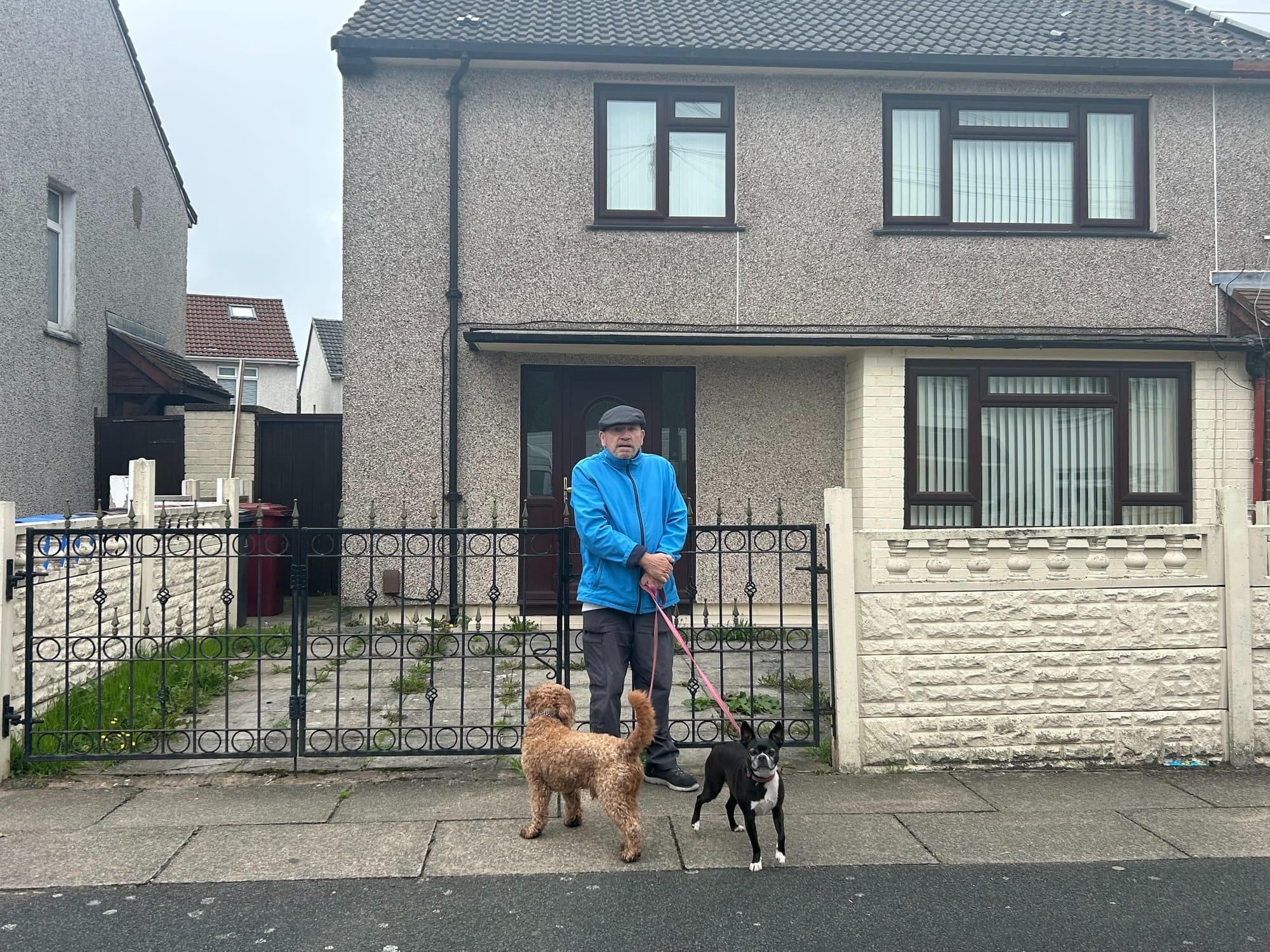
Despite the hardship, he clearly relishes the details of his past: his lorry-driver dad coming across a load of “kinky women’s boots” on the job and gifting a pair to his mum, who had no decent winter boots, so wore them under her coat while working as a lollipop lady. Friday nights, watching his sisters walk up the stairs as mortal beings and floating down as “two goddesses… because they’d done all the makeup, done their hair. I didn’t hardly recognise them.” He’d wait up for them to get in from town, not just to cadge a cigarette, but to hear their stories: who’d copped off with who, who’d snubbed who, what gorgeous men were there. His eyes gleam as he reminisces.
We’re not explicitly talking about Brezhnev, but the more Frank tells me about his mum and his sisters, the more he evokes Teresa and Elaine, the two protagonists of his film and play. Later, Frank tells me that any time he got stuck with writing dialogue, he thought of his sisters: what would they say? At another point, he describes the film as “just a big home movie”, which isn’t a metaphor: his sister Margi played the film’s co-lead character Teresa, while his sister Angela played Elaine’s little sister.
Unlike other writers of his talent, Frank never left his hometown — not really. Today, I’ve insisted that he show me the destinations where the film was once shot. He duly complies, taking me on a whistlestop tour of where Elaine’s home scenes were shot (in an actual house, which belonged to Clarke’s friends’ socialist parents, who used to herd their family into other rooms while Brezhnev filmed), plus the pub The Peacock (whose interior doubled for The Woodpecker, where the early scene in which Elaine’s bitchy friend Tracy gets a pint chucked in her face takes place). Both properties have since been transformed almost beyond recognition; I’m struck in particular by how compact the house’s living room is, and what a job it would have been to fit a cameraman, lighting and actors in it.
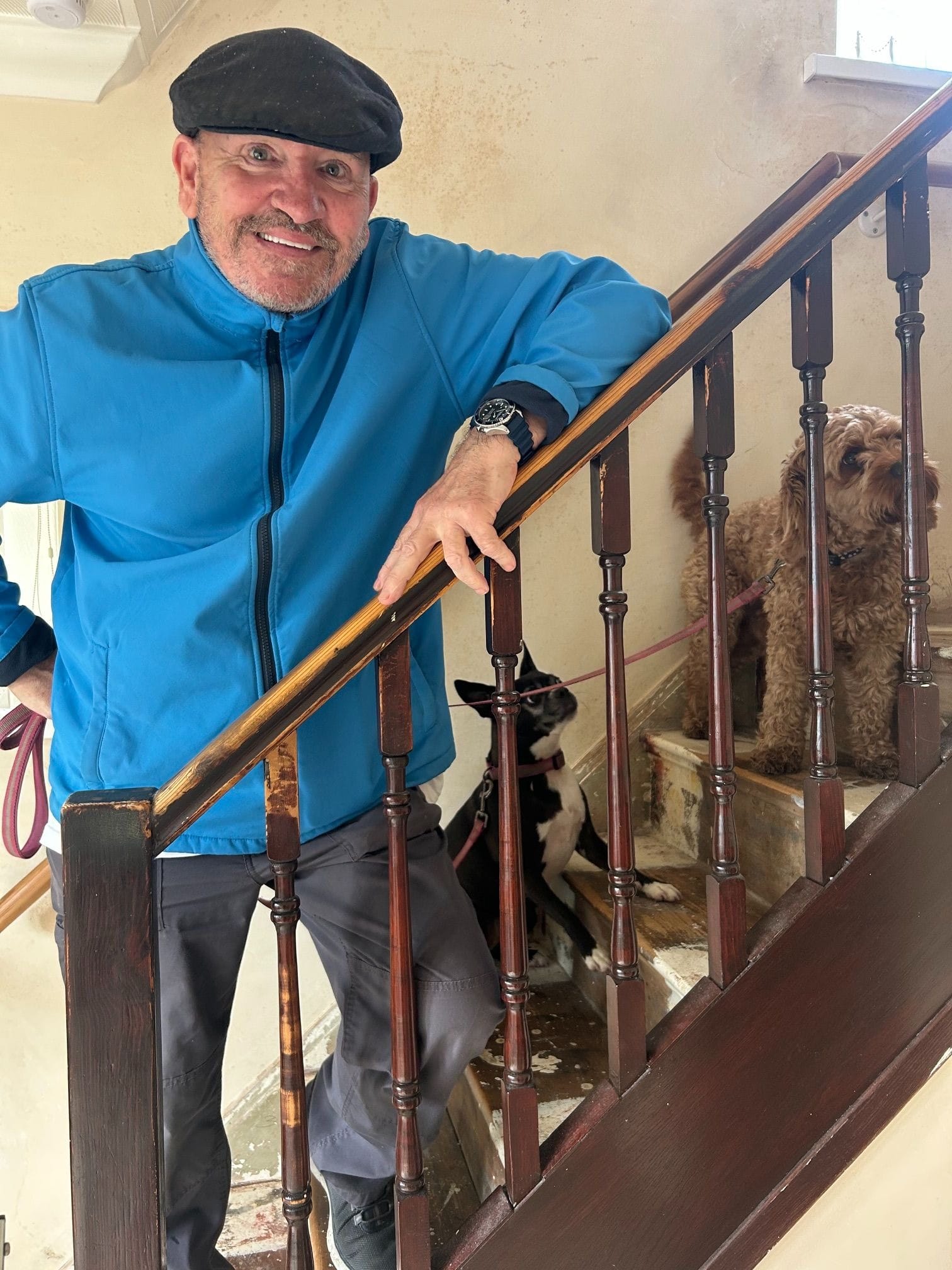
On the way back to the bus stop, we drop by one of his sisters’ to remind her about Thursday night’s premiere of Brezhnev. In the half-second I meet her, she’s wry, warm. She’s not Margi, but meeting her, I can immediately see how his family shaped his writing: she’s a more composed, self-contained version of the blonde lead, despite the cold-water surprise of a reporter dropping in with no prior warning.
When Thursday evening rolls around, a frisson of excitement runs through the audience at the Royal Court as the set is revealed. We see the blocky outline of a ship, which is a clever bit of set design: its parts are rearrangable, like a vast Rubik’s Cube, transforming into a pub, a club, a hotel, a bus, the docks, a family home, an airport. A bench will be convincingly repurposed as a car. This same playful economy of form is applied to the cast, all of whom, bar the protagonists and sailors, are required to play multiple minor roles, ducking out and reemerging in startling wigs or costume changes. It’s a smart decision by the director, infusing the production with the same breezy, improvised charm as the original.
After all, this was a film where Frank outfitted his actresses by securing an appointment with the manager of Lewis’s, the big department store in town, and instructing lead actress Alexandra Pigg to accompany him wearing high heels, a mini skirt, and a plunging top. “It wouldn’t be allowed today, would it?” he says. “It’s so sexist, but we just needed that money! She’s sitting there on the desk, cross-legged, and he’s staring at me while he’s almost signing the cheque.” (It did the trick — they got £1,000 worth of clothing, an enormous sum in 1984.)
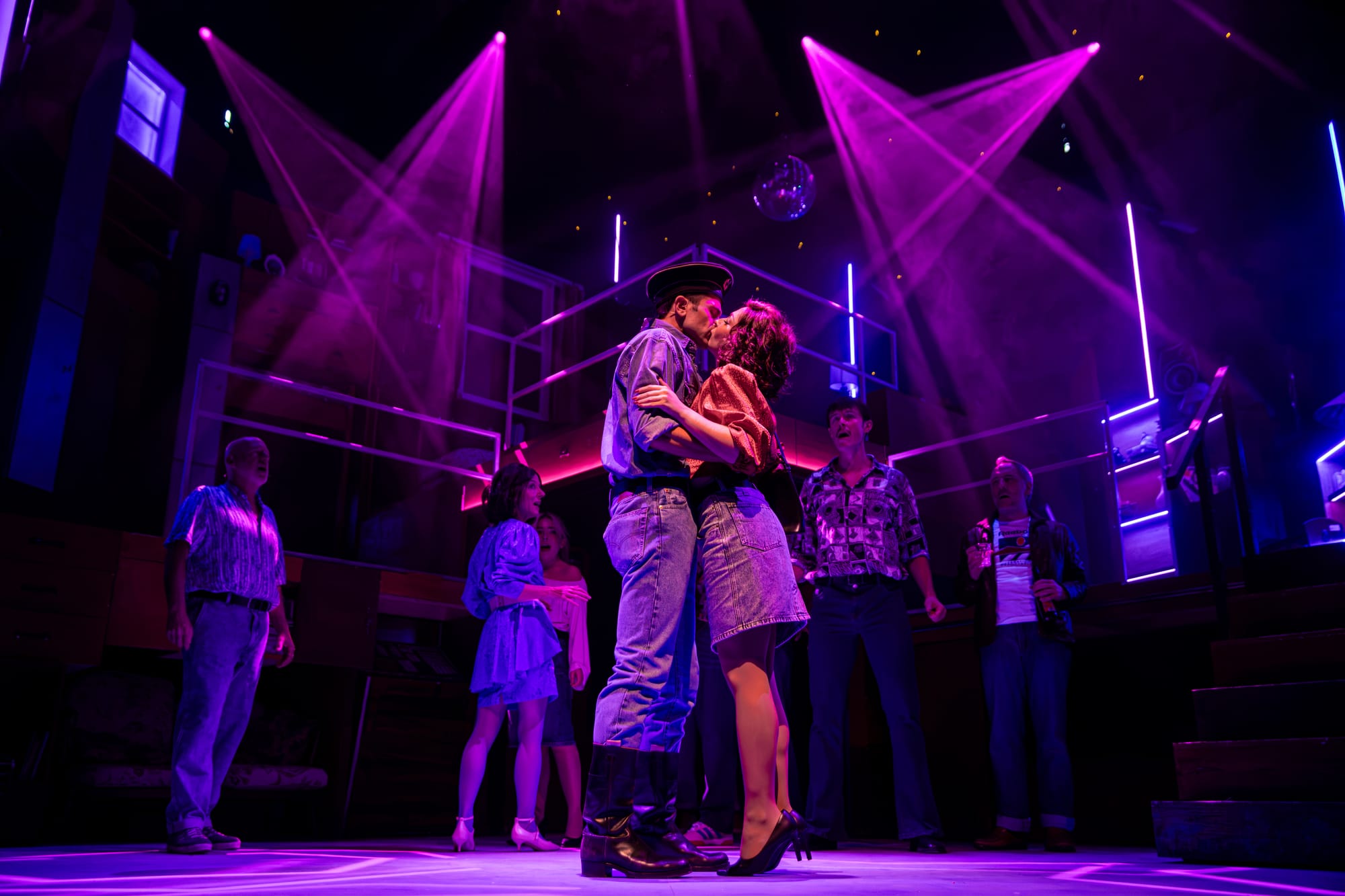
The set design is the play’s first nice surprise. The second is the cast. I’ll admit that I had an in-built resistance to the idea of a new cast — of course, the original actors would be hard-pressed to play these mostly twenty-something characters, 40 years on, but who could be more luminous than Margi Clarke or Alexandra Pigg? But by the end of the play’s electric opening scene, the new actors decimate my resistance. Frank has front-loaded many of his new jokes, which the cast bat between them at 60mph; waves of laughter erupt around me. In certain scenes, the production takes full advantage of playing out on stage rather than on celluloid. The moment where Elaine and her sailor set eyes on each other for the first time — a strangely anticlimactic scene in the film — becomes treacle-slow, choreographed so it’s dreamlike and woozy.
You almost wish for more of these flourishes where the play departs from its source material, because the moments where this new Brezhnev follows the beats of the 1985 original too faithfully — trying to do cinema on-stage — are where the production strains. The beauty of Brezhnev is that it manages to be both irreverent and funny (“He was useless [in bed]. I’d rather sit on me finger”) and enormously sincere in places. In the slower, more emotional scenes that adhere closely to the film script, the heartfelt dialogue feels flatter without the close-up shots of the actors’ faces to lend it added depth — we’re missing more dialogue to slowly build that intensity.
The play becomes a little heavier in the second act. I’m delighted to see extra scenes — especially the added comic scene and snatches of dialogue outside the chicken factory — but cumulatively, these additions slow the plot down. In the film, we’re so swept up by the action that we’re compelled to back Elaine’s occasionally questionable choices and root for love (over, say, her continuing to enjoy unrestricted freedom of movement). But here, the slower pace made me see red flags — not just as props in the scene set in the Soviet Union but in Elaine’s burgeoning relationship.
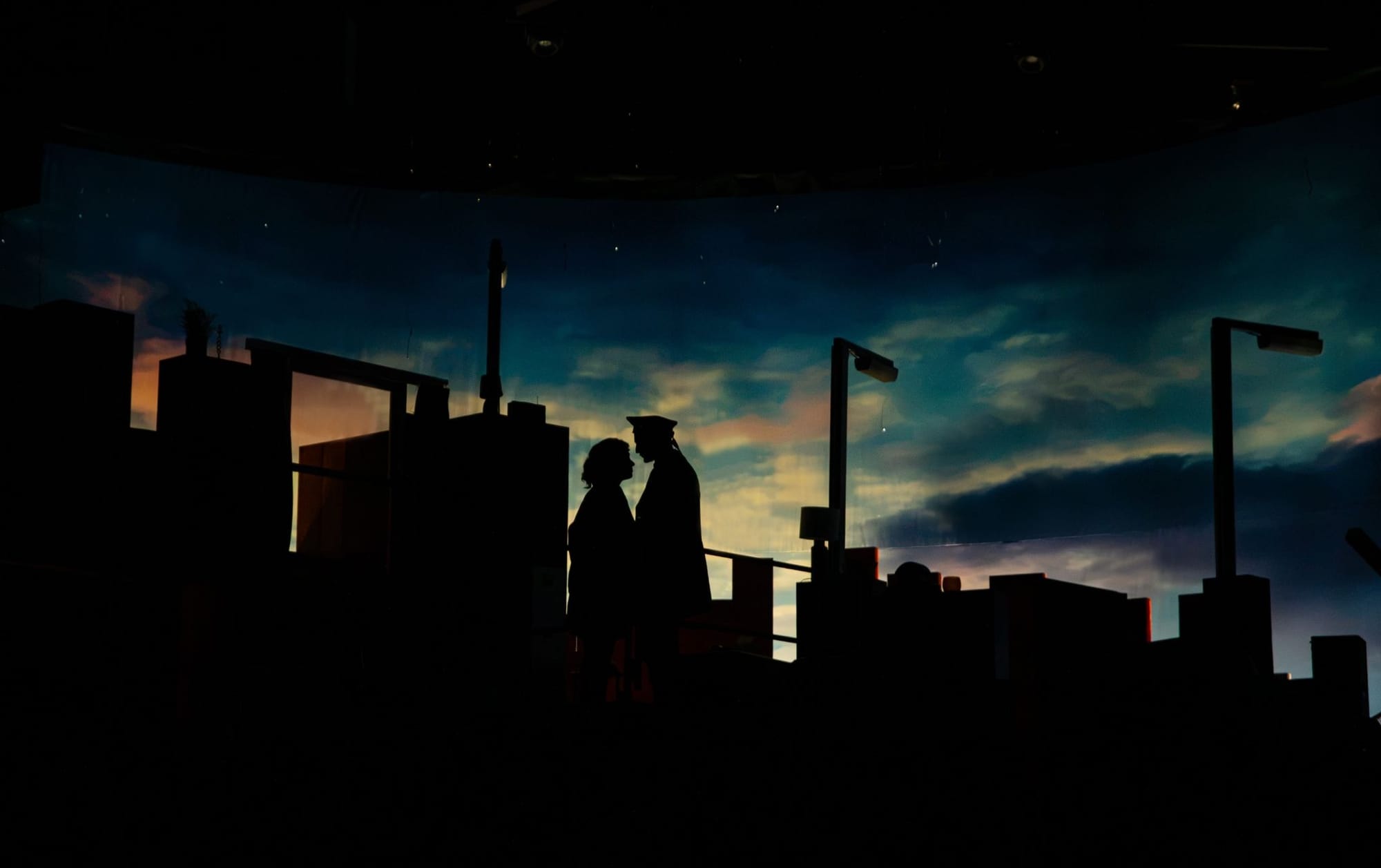
But it would be churlish to overstate what are really minor flaws in a fantastic play. The cast is startlingly good — particularly impressive were Leona Sinama Pongolle (yes, the daughter of the former Liverpool FC player Florent Sinama Pongolle) as Elaine’s bad-tempered friend Tracy and Angela Simms as Teresa. Angela has perhaps the biggest boots to fill; it’s hard for anyone to follow Margi Clarke, but she pulls it off by wisely avoiding a straight imitation of Margi’s performance. She is more of a physical comedian than her predecessor, and delivers moments of slapstick (waving her chicken factory overall like a flag at her odious supervisor, matador style) that add another layer of humour to the work.
Afterwards, chatting to Brezhnev’s original film director Chris Bernard, I ask him whether he thinks anything’s been lost in the cast being a troupe of professional actors rather than a sprawling friends-and-family group as in the original. No, he says. If anything, the cast is working at an advantage to their 1980s’ counterparts: “They have the benefit of having wages and not worrying about whether they’ve got 50p to put in the leccy box.”
Watching Brezhnev, it leaves behind a distinct sensation: a sort of tidal wave of yearning. As Roger Ebert recognised, it’s “not really about romance at all.” We part ways in the next sentence of his review: he believed the film was “about how idealism can be a way of escaping from the rat race.” Sure, but more than that, it’s about a great unstoppable yearning — not for love, but place, for adventures; to get out and to be anywhere but here (Elaine is consistent from the get go, when she sighs to Tracy that she wishes she was somewhere “all hot and exotic” like Casablanca. Tracy is unimpressed: “It rains in Casablanca as well, you know”). I phone Frank the day after the play’s premiere: how could someone like him, who is so devoted to Kirkby and has mostly never lived anywhere else, write so convincingly about being suffocated and stuck? “It wasn’t me wanting to leave Kirkby, it was the whole society wanting to get away from Thatcherism and the cruelty it inflicted,” Frank says.
Things have changed since the 1980s, but have they changed that much? Kirkby still struggles economically; people still yearn for a more adventurous life overseas. As Chris Bernard notes, the story still hits because it touches on “power and control and trying to separate people.” In the play, as in the film, Elaine and Teresa survive by dreaming of something different — just as Frank and Chris once did. It’s worth watching. We should all dream bigger, back ourselves to do vast, improbable things. Then as now, Brezhnev makes it feel possible.
Comments
Latest
Brezhnev’s back!
In Mossley Hill, one primary school’s parents are fighting against the Archbishop
Property prices in Merseyside are rocketing. But where are the hotspots?
Did the police drop the ball on Gerard Woodhouse?
Brezhnev’s back!
The 1985 rom-com is now a play. But is it still a hit, over 40 years later?